
INPEX’s growth strategy : Driving our value creation to the next stage

-
This roundtable was held in March 2026.
The data reflect figures as of the financial results announcement on February 12, 2026.
Generating profits through balance sheet control
Shinya Until recently, INPEX’s stock price was relatively closely correlated with crude oil pricesand tended to fall when oil prices declined. In 2025, however, INPEX’s stock price continued to rise even as oil prices moved sluggishly. I guess it was a year in which there was considerable interest in the Company among investors.
Yamada Our stock price began surging from the summer of 2025, surpassing 3,000 yen from November onward, and has been trading in the 4,000 yen range since February 2026. It pulled back to 3,500 yen at one point, but has since resumed an upward trend. Compared to where it used to be, it’s almost unrecognizable.
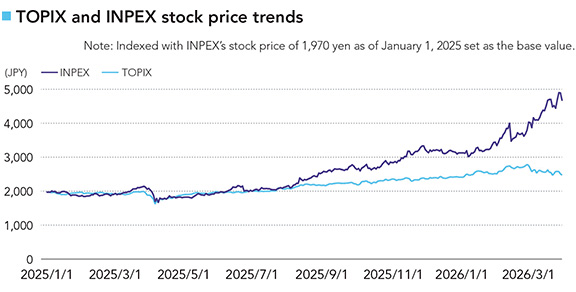
Shinya The most recent share price movements reflect the surge in crude oil prices driven by the situation in the Middle East, but the rise seen in 2025 can be attributed to management’s commitment to the share price and corporate value. What was particularly striking was how the Company clearly articulated its policy on capital allocation, including shareholder returns, strengthening its messaging to the stock market and investors about what it intended to deliver.
Yamada That’s right. The primary focus of today’s roundtable is dialogue with investors, but before we get into that, I would also like to touch on how the Company is perceived from the perspective of creditors, who are equally important stakeholders. It goes without saying that “going concern” and “enhancement of corporate value” are often framed as a trade-off, but from a practical and management standpoint, the key question is whether they can be designed to be mutually reinforcing. Our long-term credit rating is AA (Rating and Investment Information, as of March 2026), reflecting a very high assessment of our financial stability. I believe we have currently secured the financial foundation needed to pursue both going concern and corporate value enhancement in parallel. Maintaining a fine balance between the investor perspective and the creditor perspective will remain an important consideration as we pursue the Company’s future growth.
At the same time, I recognize that our stock price is still a weak point compared to our financial stability. President and CEO Takayuki Ueda has also put considerable effort into our IR activities with a keen personal interest. I believe that these efforts have been well received by investors and are gradually being reflected in our stock price. That said, looking at the recent price rise calmly, we have only just managed to push PBR above 1x, which is by no means a high level. There is still much more to do in terms of messaging, and we need to make our business leaner and more muscular to drive growth in earnings and cash flow.
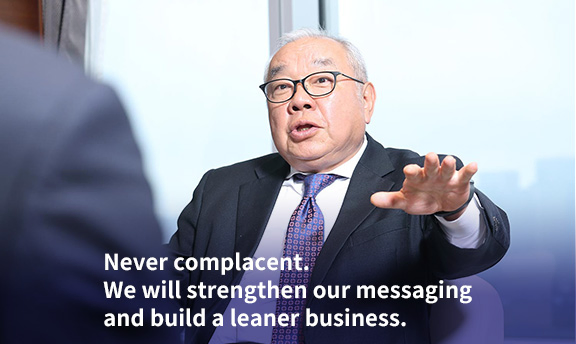
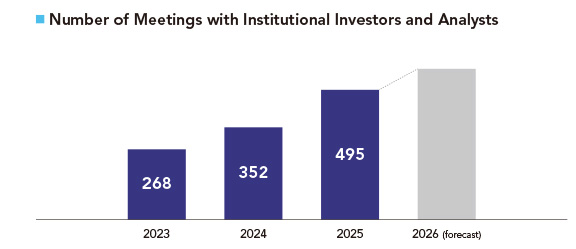
Takimoto In 2023, the Tokyo Stock Exchange requested that listed companies take action to implement management that is conscious of cost of capital and stock price. In response, we have been conducting a multifaceted analysis and assessment of our current returns on capital and related metrics, and we recognize that a review of the state of our balance sheet is a necessary part of that process. We have also been strengthening our engagement with investors, and the number of IR meetings with domestic and overseas investors held in 2025 reached a record high of 495. Increasing the number of meetings is not an end in itself, but we have been making a genuine effort to absorb the views and feedback we receive from investors in those meetings and reflect them in our management strategy and business plans. I feel that those efforts are to some extent showing up in the stock price.
That said, when it comes to our PBR and ROE, we are an asset-heavy company that incurs enormous costs in building the physical equipment and infrastructure for development and production, and it therefore seems to me that measuring us by the same yardstick as asset-light businesses such as IT companies, where the denominators of ROE and PBR are relatively small, may not be entirely appropriate.
Shinya On capital efficiency, partly because controlling equity is not straightforward, a gap remains when INPEX’s ROE is compared against the global majors. What do you think about improving capital efficiency through balance sheet management while still making the strategic investments necessary to realize sustained growth?
Yamada A direct measure to raise ROE is to reduce equity while increasing returns. However, given our current situation, with major investment in the Abadi LNG Project ahead of us, I do not believe it is a high priority to adopt a capital strategy that applies leverage in a simplistic manner through aggressive share buybacks to reduce our current equity exceeding 4.7 trillion yen. On the returns side, our profits have been recovering steadily since 2020, when they were impacted by the slump in oil prices. The contribution from the launch of the Ichthys LNG Project has been significant, and I believe that the “strength of our business” has put us on a firm footing.
Beyond that, we also need to further expand what I would call our “intrinsic earning power,” namely our ability to generate profits in a sustained and stable manner. To do that, in addition to the strength of our business, I believe we need to unlock the latent potential of our balance sheet that exceeds 7 trillion yen. We adopted International Financial Reporting Standards (IFRS) in 2023, and these are based on an “asset and liability approach” under which profit or loss is measured as the change in net assets, which are assets less liabilities. In other words, the approach calls for us to first produce our “ideal balance sheet,” and then derive our “ideal profit and loss statement” from the gap between that ideal and our current balance sheet. Our balance sheet comprises project assets deployed across the globe, and the unrealized financial and tax gains and losses embedded in it fluctuate dramatically from day to day in response to market conditions, as measured by exchange rates, interest rates, and oil prices. I recognize that my responsibility as the head of finance and accounting is to disclose to investors and creditors our “intrinsic earning power,” or in other words, our “ideal profit and loss statement,” by flexibly combining these unrealized gains and losses through appropriate asset and liability management in accordance with accounting standards.
A recent example is what we call “TA recycling,” the reclassification of translation adjustments (TA) on foreign operations, which had previously been recorded in equity as “other comprehensive income,” into profit in the profit and loss statement. TA recycling is not a one-off item but a recurring contributor to earnings growth, and I believe it has made a meaningful contribution to enhancing our corporate value through balance sheet control.
Shinya So balance sheet management generates “intrinsic earning power” from within the balance sheet itself, which in turn contributes to greater confidence in the quality of earnings.
Communication with investors to convey the growth strategy
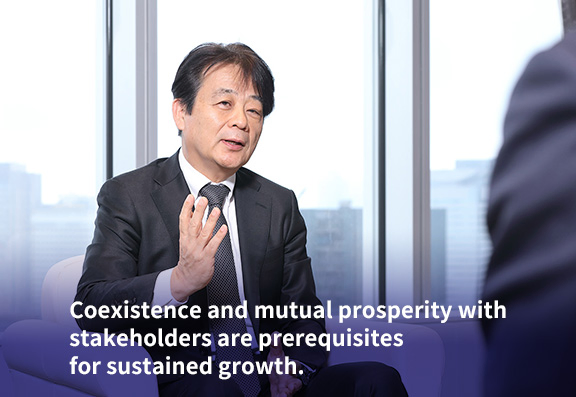
Takimoto As Mr. Yamada mentioned earlier, there is a need for well-balanced capital allocation that serves the interests of a broader range of stakeholders, including creditors, who are another important stakeholder group. Allow me to add to that. I believe we also need to appeal to four groups of stakeholders. The first is shareholders and investors. The second is the stakeholders connected with our business activities, namely customers, business partners, joint venture partners, and regulatory and licensing authorities. Creditors also fall within this group. The third is recruits and job seekers, because securing talented human resources is indispensable to the Company’s continued existence. I therefore think they are crucial target to appeal to. And the fourth group is, of course, our employees. Building close relationships with all of these stakeholders and pursuing coexistence and mutual prosperity is, in my view, a prerequisite for the Company’s sustained growth and development.
Shinya You mentioned investor meetings a little while ago. In dialogue with overseas investors in particular, I would imagine growth strategy questions figure prominently. Hearing those questions, what do you think investors feel about the feasibility of the Abadi as the next growth driver, and about the near- and medium- term growth strategy as a prelude to that?
Takimoto With the Abadi, we are currently aiming to start production in the early 2030s. We entered the front end engineering design (FEED) phase in August 2025, and some investors have told us they can now see concrete progress with the project. As we work toward a final investment decision (FID) in 2027, we are steadily moving forward with environmental impact assessments, marketing activities, and financing discussions, and our entire organization is treating this as an opportunity for a significant step-up in corporate value, succeeding the momentum of the Ichthys.
We are also increasingly being asked by stakeholders about our near- and medium-term growth strategy for the period leading up to the start of Abadi.
There is still much we are not in a position to disclose on this front, but we believe it is necessary to pursue our growth strategy for the period leading up to production, in parallel with ensuring stable funding for Abadi’s development. For example, we think it’s important for enhancing corporate value to continue making growth investments by acquiring new assets and pursuing M&A in the natural gas/LNG business and in power-related fields, where demand growth continues to be expected, while maintaining a balance between investment discipline and investment efficiency. Once these initiatives take concrete shape, we intend to communicate their strategic rationale and future outlook to investors both at home and abroad.
We also believe that it is important to pursue realistic approaches to fulfilling our social responsibility to provide a stable supply of energy while contributing to a sustainable society, including through energy decarbonization. Given the business environment over the next 10 to 15 years, namely expanding demand for natural gas, LNG, electricity, and overall energy, we see importance in pursuing business strategies that simultaneously deliver stable supply and decarbonization, such as converting coal-fired power plants to natural gas, and over the medium to long term, introducing CCS and transitioning to hydrogen and ammonia as fuels. By communicating such initiatives carefully and clearly, we also feel that it is important for our business activities and growth strategy to be firmly understood by all of our stakeholders.
Shinya INPEX is now approaching a transitional phase in which it will be executing large-scale investments. How do you intend to engage with investors and the stock market through that process? And in particular, with regard to the balance sheet management you described, Mr. Yamada, how do you plan to steer the Company while carrying out major investments?
Yamada I believe it’s possible to both execute large-scale investments and maintain control of the balance sheet. The foundation that allows us to do both is, in my view, a robust cash flow generation base and our maintenance and strengthening of the confidence financial institutions have in us.
Fortunately, we have plenty of cash flow and few concerns on the funding side, so I think we are well positioned to make massive investments for growth, including Abadi. We are also flexible in our use of leverage.Depending on project characteristics, we can select from a menu ranging from co[rporate finance such as bank borrowings and bonds to project finance, thereby contributing to the enhancement of our corporate value. Funding methodology, or in other words, debt strategy, is itself, in my view, a form of balance sheet control in the broad sense.
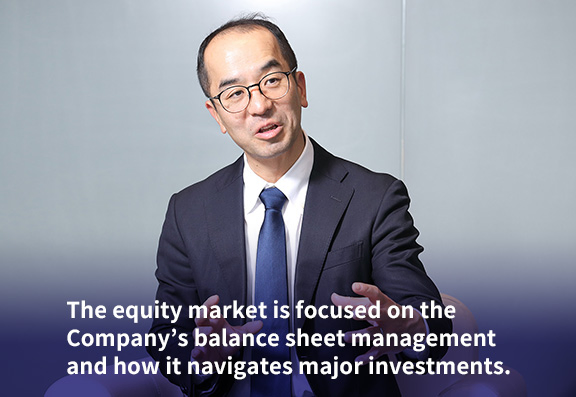
On a related note, we are sometimes compared to international oil companies (IOCs) such as ExxonMobil and Shell on growth metrics such as ROE, PBR, and PER, and told that “INPEX still has some way to go.” But personally, I am not entirely comfortable with using the same yardsticks for comparing INPEX and the IOCs. The IOCs are long-established, mature companies that have possessed major oil fields around the world since the early 20th century, whereas INPEX is a growing energy development company, as it’s only been eight years since production started at Ichthys. We are in the process of continuing investments and moving forward step by step as a growth company, including bringing Abadi toward full operation. I would ask investors not to compare INPEX with the IOCs, but to assess us with a view to what the Company will look like in the not-too-distant future. To meet investors’ expectations, we intend to utilize our balance sheet to invest in Abadi and other high-potential projects capable of generating robust cash flow.
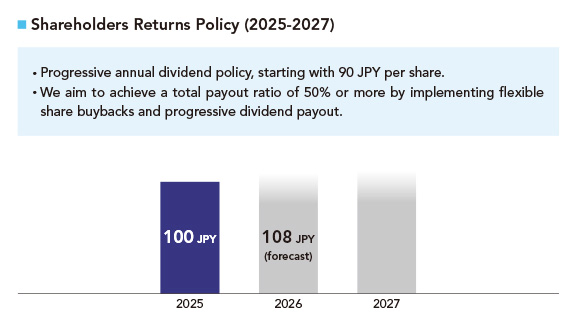
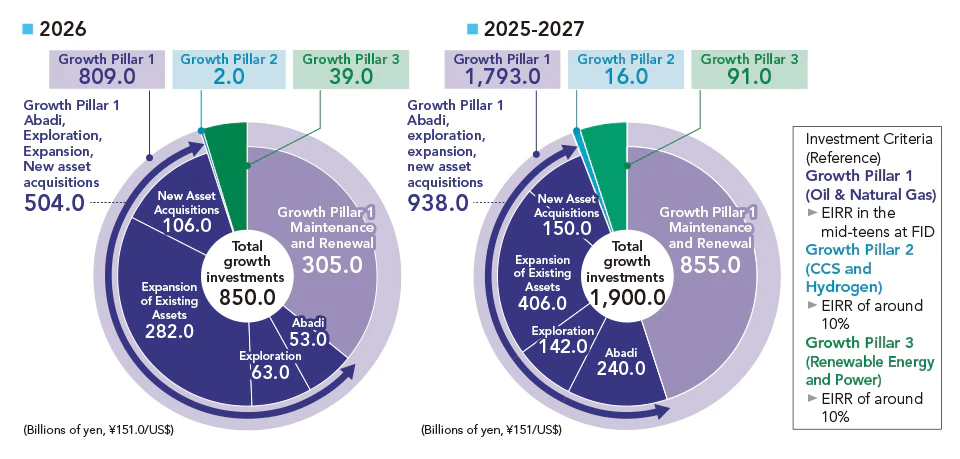
Takimoto At our recent financial results briefing on February 12, 2026, we announced total growth investment of 1.9 trillion yen over the three years of the Mid-term Business Plan through 2027, and growth investment of 850 billion yen in 2026 alone. In response, some investors expressed concern about whether shareholder returns could be maintained. We have stated, as a commitment to our shareholders and investors, that at least for the period of the current Mid-term Business Plan, we will continue to pay progressive dividends and maintain a total return ratio of 50% or more, even alongside large-scale investments.
Growth investment of this scale is necessary to make us a company capable of delivering both sustained growth and shareholder returns. We believe that it’s important to provide a clear breakdown of how much of that investment is expected to bear fruit in the near term and how much is medium- to longterm, so that the previously mentioned stakeholders can be satisfied with our well-founded approach.
Investment and divestment decision-making
Shinya What kind of discussions take place among the management team, and how are decisions reached, when it comes to investing in major projects or block acquisitions?
Yamada The management team makes investment decisions based on various considerations, including (1) the significance of the investment, specifically, whether it can contribute to Japan’s stable energy supply, (2) investment returns, such as whether it can generate cash flow that contributes to enhancing corporate value, (3) the appropriateness of the investment scale, namely whether it can be absorbed by our balance sheet, or conversely, whether the returns would be too small relative to the effort involved, and (4) whether it can contribute to innovation in our future business foundation, or in other words, whether it has value as a seed for the future. We do not make mechanical judgments, as the weighting of each factor naturally varies depending on market conditions, our financial position, and our long-term strategy.
Takimoto Our industry requires a degree of risk-taking, and in projects that begin with exploration, we are, by definition, taking on the risk of whether oil or natural gas can even be found. And the probability of success is by no means high. Raising that probability of success, efficiently developing oil and gas fields that have been discovered, and figuring out how to build the Company’s business portfolio—that, one might say, is the real essence of our business. Looking back at our history, it’s clear that our current profitable business portfolio was built through the development of oil and gas fields discovered via exploration, as well as the acquisition of production assets. In that sense, the risk-reward relationship is the primary consideration in the deliberations leading up to investment decisions. One further point on risk is that our business must consider country risk, which by its nature is beyond our control.
Since the core of our current business is upstream resource development,a certain level of risk-taking is unavoidable. That makes it all the more important to ensure that when things go well, we capture the returns properly.
Shinya Turning the question around from investment decisions, how does the management team approach decisions about withdrawing from projects, halting them, or divesting assets?
Takimoto New projects can be pursued with very high motivation, but withdrawal, termination, and divestment are by nature defensive decisions, so efficiency is the paramount consideration. In our Mid-term Business Plan announced in 2022, we set the aim of achieving “selection and concentration” in our business, articulating a strategy to focus our investment, development, and production activities on five core business regions, thereby consolidating previously dispersed management resources. This portfolio management approach has generated synergies and economic benefits within each region and enabled us to deploy our knowledge more effectively. In anticipation of such improvement effects and the emergence of knowledge-based strengths, we have carried out divestments of lower-efficiency projects, and as a result, our current portfolio is considerably lean. Going forward, as I have described, we see a need to expand the portfolio in line with our growth strategy.
Yamada As Mr. Takimoto said, the quality of our investment and divestment decisions is critical. Speaking generally, in the energy development industry, the size of the balance sheet, namely the scale of capital capacity, tends to correlate with earning power and corporate value. It is therefore important not to allow divestment to lead to a shrinking equilibrium, but rather to redeploy the cash generated through divestment into new investments. Precisely as Mr. Takimoto noted, skill in portfolio management is indispensable from the perspective of enhancing corporate value.
Building strength through the optimal combination and placement of talented employees
Shinya Finally, I would like to ask about human resources. What are the key management challenges INPEX faces in this area as a company that operates globally, and how are you approaching human resource development from the perspective of strengthening your management foundation?
Takimoto As I mentioned earlier, our employees are an important group of stakeholders, and we view securing and developing talented people, and ensuring that those people carry out their work with high levels of engagement, as vital for realizing our growth strategy. We need people who are motivated by the belief that energy resource development is a large-scale and genuinely exciting field, and who can share in our most important mission of securing stable sources of energy. While some assignments will be in regions with challenging business environments or high-hardship countries, we are convinced that personnel who can persevere amid such conditions and patiently negotiate with joint venture partners, regulatory authorities, and others to deliver project success are precisely those who will underpin the Company’s sustained growth.
The recruitment environment in recent years has remained a seller’s market against the backdrop of labor shortages driven by a declining and aging population, making it increasingly difficult to secure talented human resources year after year. In light of this situation, in 2025 we introduced a corporate branding initiative, launching an advertising campaign built around the brand message “Energy for a brighter future,” so we are working to actively attract individuals interested in joining us. Another aim is to broaden awareness, not just among job seekers but also among the rest of the general public, of what INPEX does and how we contribute to Japan. With this as a starting point, we hope to spark interest in the appeal and excitement of energy development, and ultimately build a company that draws in a wide range of people.
On the talent development side, we place a strong emphasis on learning through hands-on field experience. Exposure to development work both in Japan and overseas from an early stage, as part of training, is indispensable for gaining an overall and deep understanding of our business. As a company still on a growth trajectory, we are in a position to give people the opportunity to gain experience across a variety of departments.
Yamada It goes without saying, and this applies not only to INPEX but to every company, that growth ultimately depends on how well a company can attract outstanding talent. I think we have been able to build a workforce of talented individuals. The next challenge is how to combine our finite human resources and place the right people in the right roles. In other words, it is vital that we further maximize our latent human capital by advancing human resource management.
Shinya Leveraging the success experience from the Ichthys in Australia by sending employees who worked on it to the Abadi in Indonesia ( P.29) is itself a distinctive form of human resource utilization unique to INPEX, and a concrete expression of the importance you place on the combination and placement of talent.
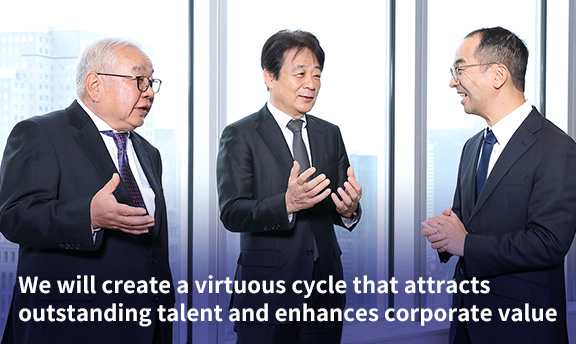
Yamada Today, we have talked about our efforts to enhance corporate value and improve PBR and ROE, but isn’t the ideal outcome a virtuous cycle in which striving to be a sound and admirable company naturally attracts more talented individuals, thereby steadily driving up ROE and, as a result, corporate value? That is the kind of company I would like us to be, one that earns the support of all our stakeholders and continues to contribute to society.
IR Related Information
-
IR related inquiries
-
IR news mail registration
-
Frequently asked questions
-
Oil market and exchange rate