
Supporting INPEX’s future challenges toward a stable supply of energy—10, 20, and 100 years from now

-
Note:This roundtable was held in April 2026.
Memorable discussions at Board meetings in 2025
Takimoto To start, I would like you all to look back on the agenda items from Board of Directors meetings in 2025 that left a particular impression, especially on the business side. Mr. Iio, could we begin with you?
Iio One discussion that left a strong impression was the debate around investment in the renewable energy business. When evaluating new projects, I always place great importance on the question of whether a given business is truly suited to INPEX. From that perspective, while I fully understand the significance of taking on the challenge of renewables itself, I believe that the form that challenge takes is critically important. For example, initiatives that involve taking on from scratch fields the Company has not previously ventured into, such as hydrogen and ammonia production, strike me as embodying the spirit of challenge that is characteristic of INPEX, as well as laying the groundwork for the future. On the other hand, I feel the Company should be cautious about making large investments in what might be called “readymade” businesses that already have many players. I believe that continuing to raise such questions is one of the most important roles of an Outside Director.
Takimoto Indeed. On renewables, discussions on the business execution side covered how to approach wind and solar power generation, areas where many players already exist, and how to reduce development costs and timelines for geothermal power generation, which can be considered a business perfectly suited to the Company. That said, there is a shared understanding that engagement in renewables is indispensable for us as an energy development company, and our policy is to move forward while taking a comprehensive approach that considers profitability alongside the question of whether the initiatives can leverage INPEX’s strengths.
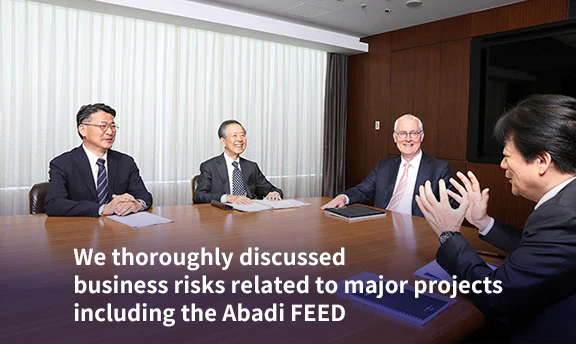
Morimoto For me, the two agenda items that stood out were the “Abadi LNG Project” and the “establishment of INPEX JAPAN and the positioning of domestic business.”
On Abadi, the Company moved into the FEED stage in August 2025. Although there have been Lessons Learnt from Ichthys LNG project, this is ultimately a project being developed in a different country, and I believe we spent considerable time engaging in thorough debate before reaching a resolution, carefully considering how to take into account global conditions as well as geopolitical and country risks. In the sense that the Board eventually steeled itself and committed to moving forward, it was an extremely engaging discussion for me personally.
On the domestic business side, and this also relates to what Mr. Iio mentioned earlier, against the backdrop of ongoing difficulties in the low-carbon solutions field, President Ueda made a remark to the effect that “Japan is our home turf, and we will hone our technology, knowledge, and experience here to prepare for the future.” This helped me appreciate that with an eye toward the future, the hydrogen and ammonia production operation in Niigata is a truly valuable business. I also feel that with INPEX JAPAN taking over the domestic business, new growth potential is coming into view. As I also mentioned at the Board meeting, by leveraging the high-quality domestic assets the Company possesses, including pipelines spanning Tokyo and eight other prefectures, with a total length of 1,500 kilometers, and a customer base extending to dozens of companies, there may also be expanding possibilities for business development that go beyond the conventional oil and gas business.
Takimoto Domestically, while natural gas production has been on a declining trend in recent years, it remains a high-quality market with strong profitability and low country risk, and we intend to pursue the launch of lower-carbon solutions businesses alongside future business expansion. And as you say, we are also considering taking on new areas such as the power business by leveraging our distinctive strengths.
Next, Mr. Miller, as a newly appointed Director, please share with us the discussions from this past year that left a strong impression on you.
Miller Like Mr. Morimoto, the discussions around the Abadi have stayed with me. Throughout this past year, as an Outside Director, and indeed as the Company’s first non-Japanese Director, I have seen one of my roles as questioning assumptions that have until now been taken for granted. As an Australian, I have also been mindful of speaking up actively from the perspective of Social License to Operate (SLO), namely how INPEX is perceived within Australia. In the context of the Abadi, we discussed matters such as the need for risk management premised on the materialization of political and geopolitical risks. As for me, from the perspective of government relations, I emphasized the importance of carefully maintaining a relationship of trust with the Indonesian government, while also considering the economic rationale of the project.
Takimoto So Abadi was the most memorable topic in terms of discussions, and the decision was made as a company after thorough deliberation at the Board level.
Analysis and recommendations on effectiveness— how to balance short-term response with medium- to long-term strategy
Takimoto Including the themes we have just discussed, are there any points that concerned you as Outside Directors in the course of business-related discussions?
Miller Rather than a point of concern, I would frame this as a suggestion for future improvement: while short-term responses are of course critically important, I believe we should also be conducting deeper analysis and discussion on how to address medium- to long-term challenges at the same time. Right now, I understand there is a great deal of short-term pressure from responding to the developments in the Middle East. However, as an Outside Director, I intend to consciously raise awareness so that we do not allow months, a year, or two years to pass by focused solely on short-term responses.
Takimoto You are absolutely right. The points you have raised have been discussed at Board meetings on multiple occasions from a medium- to longterm perspective, including at the time of formulating INPEX Vision 2035. However, with the business environment changing as rapidly as it has been, particularly since late February this year with the events in the Middle East, I feel the importance of keeping pace with those changes while simultaneously, as Mr. Miller says, continually checking from a medium- to long-term perspective that the core of management remains steady, without getting caught up in short-term events.
Miller It’s extremely difficult, but with uncertainty increasing to this extent, the excuse of “unforeseen circumstances” is no longer acceptable. Rather than being at the mercy of short-term developments, the Company needs to constantly question whether the core of management remains steady, and be prepared to respond to any situation that arises.
Iio With unimaginable things already happening, and the possibility that they will continue to happen, the Company is being tested on its ability to navigate these challenges and channel them into sustained growth, both in the short and long term. Although we are already in the midst of such circumstances, it is essential that we continuously sharpen our capacity for thinking and judgment on an ongoing basis, for the sake of the future as well.
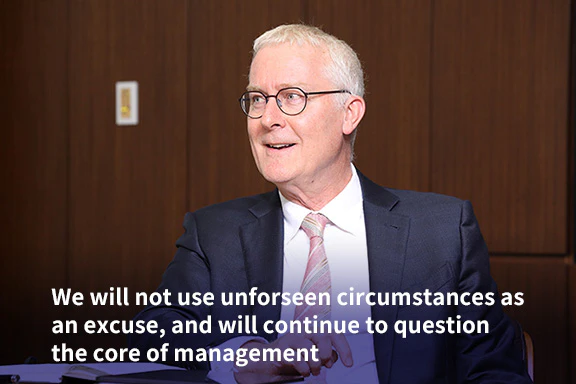
Takimoto For instance, in responding to the current situation, we identified as our highest priority the safety of all employees, including expatriates and local staff, and as our second priority the stable supply of energy, which is our most important mission, and we took measures to supply energy to our core areas including Japan, Australia, and Southeast Asia. As things stand now, we do not believe this was a mistaken course of action as a short-term response. On the medium- to long-term side, we are considering measures for the coming year while monitoring oil price movements, and next year the Board will begin discussions on a new Mid-term Business Plan and Vision. At that time, I would like us to revisit and discuss afresh the 10-year pillars for growth set out in INPEX Vision 2035.
Morimoto I would also like to offer a suggestion. Currently, investment projects above a certain scale require Board approval, but regardless of the monetary amount involved, I would like projects that relate to the Company’s broader medium- to long-term strategy and corporate direction to be explained in terms of their positioning within overall strategy at Board meetings. I believe it would be beneficial for the Board of Directors to discuss the significance of such projects from a medium- to long-term perspective.
Takimoto You are right, and I also believe that rather than discussing individual project approvals in isolation, having the Board focus its discussions on corporate policy and strategy, and clarifying the positioning of individual projects within that context, will also contribute to improving the Board’s effectiveness.
This year we have planned growth investment of 850 billion yen (up from 800 billion yen when we announced our financial results on May 13, 2026), but we need to ensure a certain level of growth even during the period before Abadi reaches production. We are also hearing requests from investors for more concrete disclosure on the breakdown of investments as well as the timeline for and likely scale of their contribution to earnings. We recognize that to respond to these requests, we need to present a growth strategy broken down into short-term and medium- to long-term time horizons. With that in mind, at Board meetings, rather than discussing investment projects in isolation, we would like them to be discussed within the context of overall strategy, organized by area and theme.
Iio In that case, having materials that convey the overall strategic picture, featuring timelines, maps, and the like, would deepen understanding and enrich the discussion.
Also, not just in this context, but in the process of formulating the Mid-term Business Plan and Vision, although the Board discusses the Company’s direction and the overall strategic picture, once implementation of the Mid-term Business Plan is underway, opportunities for medium- to long-term strategy to feature on the agenda tend to be limited until the next formulation cycle. But since the business environment is constantly changing, and business operations will change along with that, when new developments arise it will be necessary to provide explanations, along the lines of, “We are now in the second year of the Mid-term Business Plan, and this is the strategy we are currently considering.”
Takimoto That’s right. Next year will be the final fiscal year of the current Mid-term Business Plan, so discussions on the next Midterm Business Plan and Vision are likely to become quite active, but rather than having discussions only when the plan is being formulated, we should, as you point out, be engaging in substantive strategic discussions on an ongoing basis. Taking your views into account, we, as the department in charge and the secretariat, will address this issue accordingly.
Diversity underpinning Board effectiveness
Takimoto Mr. Miller, when you first joined the Board, what was your impression of the atmosphere?
Miller Before taking on the role of Outside Director, I had some concerns, wondering whether INPEX might have a bureaucratic atmosphere, and whether the Board was functioning properly. But when I actually attended a meeting, I found a very open atmosphere with high-quality discussions taking place. The Outside Directors actively contribute based on their respective areas of expertise, and I think this is what drives such lively debate.
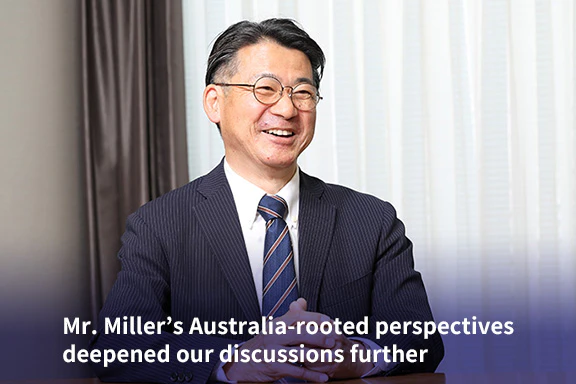
Morimoto Since Mr. Miller joined us, I feel that the Board’s discussions have deepened further. Until then, all the members had been Japanese, so there was an inevitable tendency to view things through a Japanese lens. Having Mr. Miller tell us “how things look from Australia” has led us to think more about “what we should be doing for Australia.”
Iio When I joined the Board in 2017, many of the Outside Directors, myself included, came from exploration and production (E&P) backgrounds. Since then, there has been a gradual increase in members with different attributes and backgrounds, and with Mr. Miller joining last year, diversity has advanced even further. When everyone shares the same background, there is a natural tendency to simply agree with one another, but as diversity increases, we can prevent such groupthink and avoid blind spots, and it clearly leads to an improvement in the quality of discussion.
Takimoto Speaking from the business execution side, having Mr. Miller join the Board as our first non-Japanese Outside Director has brought new insights, introducing different perspectives on decisions around entry and exit from businesses and on how to view risks and opportunities, while also deepening discussions and contributing to the enhancement of corporate value. And from this year, Ms. Saiki, who had a distinguished career at the Ministry of Foreign Affairs, has also joined as an Outside Director, and we look forward to receiving valuable input from her on risk management in our overseas business and on our efforts in resource diplomacy and international relationship-building. Similarly, Mr. Takaoka, who has also newly joined as an Outside Director, is expected to offer insights for our medium- to long-term growth strategy, investment decisions, and governance from a perspective informed by his experience in the energy business and global management at a general trading company.
Iio I would also like to add one point, and it is something I am mindful of myself. Outside Directors must never lose sight of the big picture, and when offering advice, must remain conscious of their role and strictly refrain from intruding into the work of the execution side. I believe that a proper awareness of role delineation at the Board level leads to more vigorous discussion and improved effectiveness.
Miller It’s true that there is a line between the roles of Outside Directors and Executive Officers, but for my own part, I make a point of asking questions without hesitation whenever I sense something is off or have a doubt. I don’t think it’s right for Outside Directors to hold back from asking questions simply because responsibility for the matter is on the execution side.
Morimoto In view of the direction of governance reform, independent Outside Directors, from their objective standpoint independent of the execution side, are expected to delegate specific business decisions to the execution side in normal times, while themselves engaging in broad strategic discussion and decision-making by providing oversight and advice. I believe we are already doing this, but it’s something we must remain conscious of going forward.
Takimoto We very much welcome having views shared from a wide range of perspectives, as it contributes to improving the quality of our business itself. We hope you will continue to speak freely.
People and organizations as the foundation supporting corporate value
Takimoto As Outside Directors, how do you view the challenges the Company must overcome to enhance corporate value? Please share your thoughts.
Iio I believe INPEX’s greatest value lies in possession of high-quality assets such as Ichthys, and that developing the people who drive the business development behind this is the most important challenge. For sustained growth, what is indispensable is not only individuals with deep specialist expertise, but also people capable of making comprehensive judgments that transcend the boundaries between technical and administrative functions. I would like the Company to reconsider its approach to human resource development, broadening employees’ perspectives by giving them experience across different departments and organizations, but also balancing this with talent development that deepens specialization.
Takimoto I agree. You are absolutely right on human resource development. In particular, succession planning is critical not only for senior executive roles, but also for specialist functions, such as general managers for the Finance & Accounting Division, Corporate Strategy & Planning Division, Technical Headquarters, and each regional project division.
On the development of specialists, it cannot be denied that spending a long time in the same department doing the same work can lead to a lack of knowledge in other areas and an inability to see the organization as a whole, which poses the risk of inability to make decisions that are optimal for the organization overall. There’s no single right answer here, but based on the views you have shared, we’d like to revisit this internally and work toward identifying better approaches.
Miller As for challenges for enhancing INPEX’s corporate value, I would highlight three: talent, diversity, and Social License to Operate (SLO).
On talent first, as INPEX’s global presence continues to grow, securing excellent people will become even more critical if the Company is to reach the next level. I believe there are clear compensation and evaluation frameworks in place, but it may be time to reconsider them with an eye toward what global best practices look like. On diversity, as I mentioned earlier, in an environment of heightened uncertainty, diverse perspectives improve the quality of decision-making, so I believe diversity that encompasses not just gender but also differences in perspective, experience, and specialization will become increasingly important. Finally, on SLO, across all the regions in which the Company operates, including Australia, Indonesia, the Middle East, and Japan, relationships of trust with society are a prerequisite for continuing operations, so maintaining them contributes directly to enhancing corporate value.
Contributing as Outside Directors
Takimoto Finally, could you each share how you hope to leverage your experience and knowledge to contribute to management and the Board going forward?
Iio I worked for a general trading company and have gained extensive experience on the front lines of the resources and energy sector, while also being involved in management for many years. In that sense, I believe I have a deep understanding of and affinity with the Company’s business and projects. At the same time, over my long career there have been successes, but also many failures. Drawing on the Lessons Learnt from those experiences, I strive to support the Company’s growth by speaking frankly at Board meetings rather than simply going along with the majority when something does not sit right with me. INPEX is a company with a fine tradition and culture. I am sure there will be lots of new initiatives and projects ahead, and I hope the Company will chart a path of growth that is truly its own: distinctively INPEX.
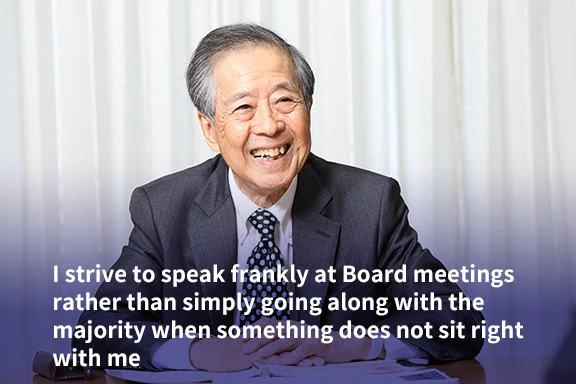
Morimoto I joined the then-Environment Agency (now the Ministry of the Environment) in 1981 and worked in environmental administration, and particularly after Japan’s carbon neutrality declaration in 2020, I was also engaged in energy administration in coordination with the Agency for Natural Resources and Energy under the Ministry of Economy, Trade and Industry. The current environment for the lower-carbon solutions business is extremely challenging. Over the long term, however, I believe the global trend toward low carbon and decarbonization will remain unchanged. For INPEX, whose mission is to provide a stable supply of energy --particularly to Japan --initiatives that anticipate this trend are essential. Where I believe I can contribute by drawing on my own experience and know-how is in supporting the pursuit of the lower-carbon solutions that are essential to fulfilling that mission.
Miller I have spent many years working on geopolitical risk management at the national level, not only in Australia, but in other countries too, and I hope to tap into that experience in my contributions here. I also serve as an Outside Director at another company. Although I cannot say whether this is truly accurate, people in Australia often say, “Bruce Miller is the conscience of the board, so if you want to know what’s right, ask Bruce.” I hope to contribute in a similar way at INPEX in the areas of governance and compliance. On compliance in particular, I believe it’s important to instill a culture of asking “what is right” rather than being satisfied with simply having rules in place, and I view offering candid opinions in service of that goal is one of the key roles of an Outside Director.
Takimoto From our side, we of course hope to hear your perspectives from abroad as a non-Japanese Director, but also, given your deep familiarity with both Japan and Australia, we would very much welcome your views on matters such as the Japan-Australia relationship, how we should approach Japan-Australia investment, and what measures we should take to stabilize the investment environment.
Miller In fact, in Australia, I am known as someone who has said “no” to several ministers, including prime ministers. That means I tend to blurt out whatever is on my mind.
Takimoto We look forward to hearing your frank and unvarnished opinions at our Board meetings as well. And it would be wonderful if your candor inspires other Board members to speak up freely too, leading to lively and open exchanges of views.
Everyone, thank you very much.
IR Related Information
-
IR related inquiries
-
IR news mail registration
-
Frequently asked questions
-
Oil market and exchange rate