
Our Policy
As a company that operates projects in roughly 20 countries worldwide, INPEX recognizes that the procurement of materials, equipment, services, and construction work, as well as building appropriate relationships with the suppliers that provide them, including contractors, are key issues. Our Details on Ethical Procurement Guideline expressly prohibits impediments to fair and impartial competition, abuse of dominant bargaining positions, and inappropriate granting or receipt of benefits. It also requires that we protect the confidentiality of supplier information and technologies. In addition to that fundamental policy on procurement, it requires our officers and employees to comply with our Mission, Sustainability Principles, and Code of Conduct, which defines requirements for conducting our business, for the purpose of fair and impartial procurement. As part of supplier management, at the annual supplier forum, we invited about 100 domestic suppliers involved in our domestic operations and explained our CSR (Corporate Social Responsibility) self-assessment surveys and CSR audits, while requesting their cooperation. We will continue to strengthen our relationships with suppliers through this forum and by regularly creating opportunities to improve supplier capabilities and environmental, social, and governance (ESG) performance. We will also engage in competitive procurement, carry out risk management that includes CSR and performance assessments, and work to strengthen supply chain resilience.
Procurement Overview
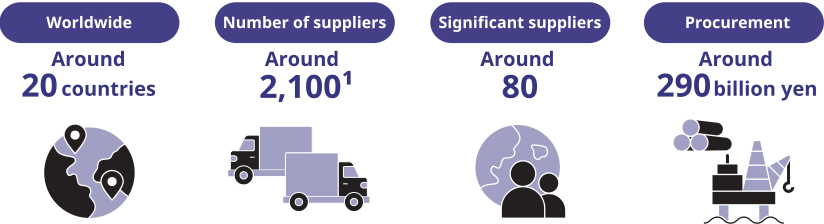
-
1Suppliers are only Tier-1 suppliers (Tier-2 suppliers are not included)
Management Structure
Based on the Details on Ethical Procurement Guideline and the Code of Conduct, the Board of Directors bears accountability and decision-making responsibility for matters related to corporate ethics and corporate conduct. If a supply chain issue arises, the officer responsible for the supply chain promptly reports it to the Board of Directors. Based on that report, the Board makes timely and appropriate judgments and decisions. In addition, the Sustainability Committee, which is held every December and includes the Representative Director, President & CEO and other members such as the Chair of the Compliance Committee, discusses external assessments of our supply chain management and the direction of our future initiatives.
Supplier Code of Conduct and Supplier Code of Conduct Guidelines
In July 2022, we established our Supplier Code of Conduct, which clearly outlines our expectations of our suppliers in the following seven ESG-related areas to address ESG throughout our supply chain.
Supplier Code of Conduct
| Area | Overview |
|---|---|
| Human rights and labor rights | General principles of human rights, including elimination of child labor and discrimination, and protection of workers that includes ensuring a safe, hygienic and healthy work environment. |
| Fair business practice | No bribery, collusion or cartels, or association with antisocial forces, etc. |
| Environment | Prevention of environmental destruction through business activities, and reduction of CO2 emissions, etc. |
| Confidentiality | Protection of personal and confidential information obtained through business operations. |
| Local community | Promotion of coexistence and co-prosperity with local communities. |
| Whistle-blower system and grievance mechanism | Establishment of a whistle-blower reporting system and training sessions conducted for employees on how to use it. |
| Disclosure | Disclosure of ESG-related information and ensuring transparency. |
We require suppliers to comply with the Supplier Code of Conduct by including it in our standard contracts and having it accessible via our website.
In June 2023, we issued our Supplier Code of Conduct Guidelines. These guidelines contain explanations and conduct examples, to promote greater understanding of and compliance with the code among our suppliers.
- Details on Ethical Procurement Guideline
- Supplier Code of Conduct
- Supplier Code of Conduct Guidelines
Supply Chain Management
Each year, the INPEX Group procures approximately 290 billion yen in goods and services from roughly 2,100 suppliers. Procurement from our significant suppliers accounts for roughly 230 billion yen of this figure. We take the following actions to manage risks within our supply chain.
First, in supplier selection, we provide procurement opportunities to domestic and overseas suppliers according to the needs of each project. We also actively consider procurement from new suppliers. As a rule, the supplier selection process uses competitive bidding or competitive quotations from multiple companies. We evaluate suppliers comprehensively in terms of quality, price, delivery, technical capabilities, and stable supply. In these evaluations, we also consider ESG factors such as compliance with laws and regulations in each country, our Anti-Bribery and Anti-Corruption (ABC) Policy, labor safety performance related to HSE, and CSR risk management. We conduct procurement activities with due regard for fairness and impartiality. We request quotations only from suppliers that we determine meet our requirements based on these criteria.
At the contract stage, we require suppliers to comply with labor and environmental laws and regulations, comply with our Supplier Code of Conduct, and respect our Human Rights Policy, and we include these requirements in our contracts.
We encourage employees in our supply chain division to attend internal training on laws and regulations related to procurement activities, such as the Antimonopoly Act and the Act on Ensuring Proper Transactions Involving Specified Entrusted Business Operators (formerly the Act against Delay in Payment of Subcontract Proceeds, etc. to Subcontractors), as well as information security and our ABC Policy, and we strive to ensure compliance.
Since FY2024, we have held a Global Supply Chain Forum with supply chain divisions at our overseas sites to strengthen supply chains across the INPEX Group. As one agenda item at this forum, we shared our recognition of issues related to CSR operations and examples of relevant initiatives.
In addition, through supplier screening and assessments, we review procurement processes and discuss improvement measures. We also work to consider and implement preventive and mitigating measures for risks across the entire supply chain. Specific activities are described below.
Supplier Screening
In our domestic operations, we conduct two-stage supplier screening based on ESG risks in the supply chain and business importance.
As the first stage of screening, we sent CSR self-assessment surveys to suppliers whose order amounts exceeded a certain threshold. Based on the survey scores for ESG items, we then carried out second-stage screening of suppliers deemed to have sector and commodity risks (industries and products with high human rights risk) and country risks (countries with high human rights risk) and conducted CSR audits. Records of these risk assessments are properly managed and used in future supplier selection and other processes.
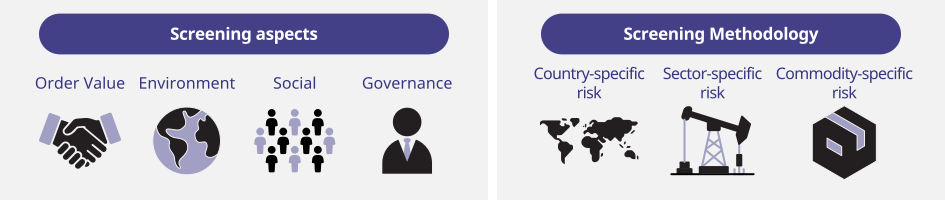
We conduct supplier assessments for significant suppliers identified through screening and for suppliers assessed as high risk through the initiatives above. Through these assessments, we promote improvement activities and avoid or reduce risk, including by reviewing contracts.
Supplier Assessment
We conduct annual assessments using CSR self-assessment surveys, focusing mainly on suppliers with the highest order volumes. In FY2025, based on the results of our human rights due diligence, we substantially revised the survey to expand the scope of our review of the salient risks we identified. We added questions on human rights and labor rights, occupational health and safety, procurement practices, local communities, the environment, compliance, and other topics. This allowed us to conduct environmental, social, and governance assessments that go beyond compliance items in the Supplier Code of Conduct. In FY2025, we received responses from 60 suppliers, including 14 significant suppliers. Over the past three years, 37.6% of suppliers have completed CSR self-assessment surveys. In FY2025, we conducted second-party audits led by us on four suppliers using our CSR self-assessment surveys. In addition, we regularly conduct third-party on-site audits at plants, construction sites, and other locations using external consultants' standards developed based on international standards such as the ILO conventions and SA8000, from the perspectives of the environment, society (labor, wages and working hours, and health and safety), and management systems. These assessments identified no material issues regarding human rights, labor, the environment, or other social expectations in our supply chain. Accordingly, we did not implement any corrective actions.
Case Study: INPEX Australia's Industry Participation Plan
INPEX Australia's Industry Participation Plan for Ichthys LNG commits to providing full, fair, and reasonable opportunities to Australian suppliers. These commitments are cascaded to suppliers and contractors through our contracts and procurement processes. Regular progress reporting and scheduled meetings with significant suppliers and contractors are incorporated to assess levels of local content achieved against submitted plans and targets.
Our supplier opportunities portal on the INPEX Australia' website provides guidance to suppliers seeking opportunities with INPEX Australia.*1
-
*1
Related Page
-
Respect for Human Rights
-
Modern Slavery Act Statement
-
Response to Feedback from Stakeholders
-
Human Rights Due Diligence