
Establishment of Various Inquiry and Grievance Mechanisms
The INPEX Group operates various inquiry and grievance mechanisms to be accessible to all stakeholders. We consider protecting the privacy of whistleblowers and those who consult us, and we also accept feedback anonymously.
Various Inquiry and Grievance
| Contact Points | Scope |
|---|---|
| Whistleblowing contact point | Officers and employees of the Group (including former employees within 1 year of leaving the Group) |
| Whistleblowing contact point for external stakeholders | Shareholders, investors, business partners (including suppliers, contractors, and security guards), NGOs, and local residents |
| Labor-management council | Employees |
Development and Operation of the Whistleblowing Contact Point
In terms of the whistleblowing contact point, we have established a helpline for receiving all reports and consultations, including those related to compliance matters such as discrimination, human rights, and harassment, in both Japanese and English. We have also launched the INPEX Global Hotline with support in roughly 20 languages, including local languages of the areas in which we operate. The helpline has internal and external (law firm) contact points, while the INPEX Global Hotline is wholly administered by an external service provider. Reporting and consulting can be completed anonymously. To accommodate whistleblowers in a wide range of circumstances, methods such as email, telephone, and letter can be used.
Please refer to Response to Whistleblower Reports for details on protections for whistleblower privacy and post-reporting procedures.
Establishment and Operation of the Whistleblowing Contact Point for External Stakeholders
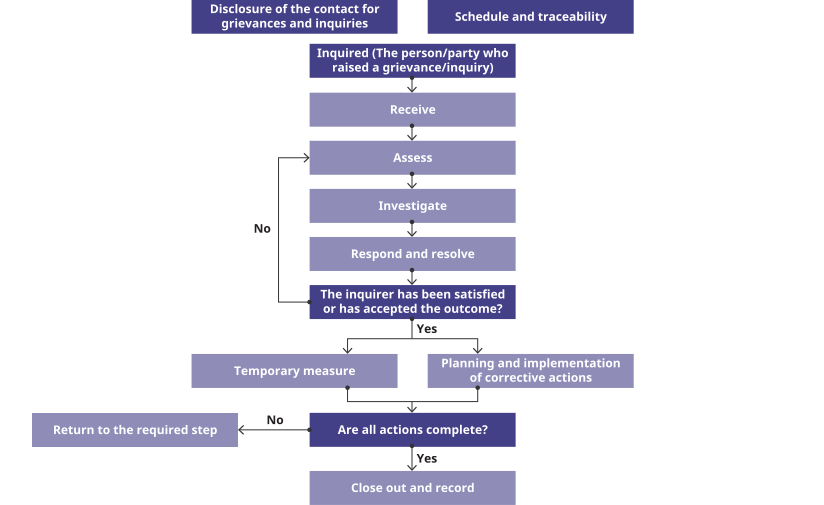
We recognize grievances may arise from external stakeholders in relation to the Group's business activities. We have defined a process for identifying, investigating, and resolving any such external grievances, and we conduct dialogue with local communities and other stakeholders.
Response Process
1. Acceptance
All operational organizations accept a wide range of feedback, including on social and environmental matters, through multiple channels suited to each region and business. These include telephone, email, letter, and face-to-face dialogue with office representatives. All information received is properly managed with due care for personal data protection and confidentiality obligations.
2. Initial Assessment and Investigation
After receiving a report, we assess the magnitude of its impact on the complainant and other stakeholders. As needed, we conduct investigations with an emphasis on fairness and objectivity, including fact-finding, interviews with relevant departments and parties, and on-site inspections.
3. Response and Remediation
Based on the initial assessment and investigation results, we consider and implement appropriate response measures. If harm or disadvantage has occurred, we take remedial action, including corrective measures and measures to prevent recurrence. When a matter is urgent, we implement response measures even while the investigation is still underway.
4. Management and Recordkeeping of Grievances
We explain the outcome of the response to the complainant and confirm whether they understand and accept the outcome. Once all responses are complete, we close the case. Feedback received, response details, and lessons learned are recorded and used to monitor feedback trends. We strive to identify any new areas of concern as early as possible and minimize potential risks. Should we receive grievances from local communities, we respond in the local language and follow our established procedures to ascertain the facts and provide appropriate responses, in collaboration with relevant stakeholders.
No grievances requiring corrective actions were received at any of our operational sites during FY2025.
Example of the Process for Responding to Grievances and Inquiries
Feedback from Local Communities
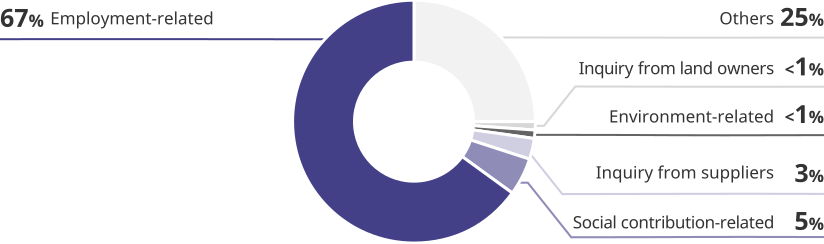
Below is the breakdown of inquiries and feedback from local residents received during FY2025, in line with our procedures for responding to external stakeholders, at sites in which the Group operates as the project operator.
Breakdown of Inquiries and Feedback from Local Communities in FY2025
Case Study: Grievances and Responses
As an example of a grievance, during construction of our Kashiwazaki Hydrogen Park, local residents complained about traffic congestion caused by vehicles waiting to turn right to enter the site. We responded by establishing a rule prohibiting right turns for entry, which helped alleviate the congestion. At the Nagaoka Field Office, snow piled up by a contractor we had engaged blocked part of a farm road. We contacted the contractor and incorporated the issue into the work specifications to prevent similar incidents from occurring.
Labor-management Meetings
The INPEX Labor Union is made up of a central head office and branches and has established its branches at our five key sites in Japan. Furthermore, the central head office manages and handles seconded employees in Japan and other sites without branches. The central head office and branches engage in close communication and dialogue regarding labor-management issues through biannual central labor-management meetings and labor-management meetings by five branches. Union officers go on-site to overseas sites once per year to engage in direct discussions with employees stationed overseas. They conduct local labor and living condition studies, perform document-based fact-finding studies for areas they were unable to visit in person, and share information regarding actual conditions at overseas sites and requests from locally stationed employees with the Company (the head office Human Resources Unit and overseas offices) to address problems and make improvements.
Engagement with Local Communities
As of the end of FY2025, consultations with local communities have been conducted for 100% of the 42 production/operation projects in which we hold interests (including 26 oil and natural gas projects) as well as all 12 development/construction projects (including 3 oil and natural gas projects). The projects where we serve as the operator are listed below:
Production Assets / Operating Sites
Oil and Natural Gas Business
- Ichthys LNG Project (Australia)
- Naoetsu LNG Receiving Terminal and pipeline network (Japan)
- Minami Nagaoka Gas Field (Japan)
- Naruto Gas Field (Japan)
- Yabase Oil Field (Japan)
Other Businesses
- INPEX Mega Solar Joetsu (Japan)
Development/Construction Projects
Oil and Natural Gas Business
- Abadi LNG Project (Indonesia)
Other Businesses
- Katatsumuri Yama Power Plant Geothermal Power Project (Japan)
- Nagaoka Methanation Demonstration Project (Japan)
- Kashiwazaki integrated blue hydrogen and ammonia production and utilization demonstration test project (Japan)
At our head office and overseas offices, we hold regular meetings to address common and emerging environmental, social, and governance issues and share the latest information about stakeholder engagement in each jurisdiction for the development of future action plans.
Japan
We have established contact points for local communities at the Group's operational sites in Japan (Niigata, Minamiaga, Nagaoka, Kashiwazaki, Joetsu, Akita, and Chiba) and engage in dialogue with stakeholders in the areas where we operate.
Every year, we actively participate in community events, including providing sponsorship and volunteer support for a marathon in Kashiwazaki. Additionally, we sponsor firework displays at summer festivals in Niigata, Nagaoka, Kashiwazaki, Joetsu, and Akita. Collaborating with local residents of Nagaoka, we contribute to environmental conservation through a semiannual reforestation project. Furthermore, the Naoetsu LNG Terminal—the core facility of the Group's gas supply chain and the receiving terminal for LNG shipped from the Ichthys LNG Project in Australia—publishes a bimonthly newsletter for local residents, municipal offices, and government agencies to inform them on the terminal's operations, safety efforts, and other matters. Our employees also engage with local residents through involvement in community activities such as softball tournaments.
Case Study: Worksite Tours for Local Residents
When constructing gas pipelines in Japan, we ensure free prior and informed consent (FPIC) is received from local governments, and residents and companies along the route. To do this, we offer pre-construction briefings, circulate notices about the work, and provide worksite tours. As a standard practice, we typically select pipeline routes that pass under public land, such as public roads, thereby minimizing the need for residents to relocate.
As an exception, when conducting shield tunneling and jacking work, we negotiate with landowners along the route to lease the minimum area of land required for the construction period. We then pay a fee to lease the land for the duration of work. When leasing agricultural land, such as rice paddies and vegetable gardens, we financially compensate farmers for the duration of our work and according to the crops being grown. Based on the construction plan, we invite landowners to briefings and site visits before work commences. After the construction is completed, we promptly restore the land to its original condition, obtain the landowners' consent, and return the land to the landowners.
In the survey and design work for the Metropolitan Area CCS Project currently underway, we will continue our review as we work toward a commercialization decision by providing briefings to local governments as well as residents, companies, and landowners along the planned project route, and incorporating their feedback into the design as needed. We have also launched an official website of the Metropolitan Area CCS Project and created videos introducing the project, covering its overview, the CCS process, and safety considerations. Through these efforts, we are actively disclosing information and accepting a wide range of opinions and questions about the project via an online inquiry form.
Australia
In Australia, we strive to develop strong and trusted relationships in the communities where we have a presence by actively engaging and working closely with key stakeholders - including authorities, industry/business, and civil society organizations - and the broader community to ensure we readily communicate relevant information about our activities, understand the implications of these activities on community and stakeholder interests, and receive valuable feedback on our business practices and performance.
We conduct engagement activities in line with our principles for stakeholder engagement to ensure:
- Proper identification and prioritization of stakeholders
- Regular contact with priority stakeholders
- Appropriate engagement of Aboriginal and Torres Strait Islander peoples, language groups, native title holders, and organizations in the conduct of commercial activities
- Proactive communication on issues and impacts
- Easily accessible information
- Consistent, timely, and responsive communication
- Continuous monitoring and improvement
We draw insights from our engagement activities to help guide the Group's business conduct and management of potential impacts, and consider and incorporate the views of impacted stakeholders into our business decisions and activities.
We use a range of communication methods to suit the engagement purpose and stakeholder preference, including face-to-face and virtual meetings, industry and community forums and events, emails and online information, mainstream and social media, advertising, and communications collateral.
We also publish a toll-free phone number, email address, and inquiries form on our website and through other channels for local community members to provide feedback on our activities. In FY2025, we received 733 inquiries, a significant increase compared with 583 in the previous year. Most inquiries received to employment opportunities (22% from Australian residents, 51% from overseas job seekers).
Kimberley Community Update - July 2025
Kimberley Community Update - Dec 2025
Community Engagement in the Northern Territory 2025
Indonesia
We strive to maintain productive communication with relevant stakeholders for the Abadi LNG Project in Indonesia. This includes not only local communities, residents, and other stakeholders directly impacted by the project operations, but also NGOs and the central, provincial, and local governments. As part of this commitment, we assign employees who were raised in the areas surrounding the project site to the operational site. This enables them to directly support our efforts to maintain active dialogue with those local communities.
Regarding the environmental and social impact assessments currently underway, we developed a Stakeholder Engagement and Public Consultation Plan (SECP) ahead of the public consultations for local residents that are held as part of the Indonesian Environmental and Social Impact Assessment process (AMDAL). The SECP goes beyond the requirements of the AMDAL to incorporate stakeholder engagement requirements stipulated in the Performance Standards of the International Finance Corporation (IFC), which are globally recognized guidelines for environmental and social risk management. We are implementing initiatives in accordance with the SECP.
Our stakeholder engagement in each process of the environmental and social impact assessments is summarized as follows.
Stakeholder Engagement in Each Process of the Environmental and Social Impact Assessments
| FY | Processes | Stakeholder-related Initiatives |
|---|---|---|
| 2018 | Identification of stakeholders |
|
| 2019 | Development of SECP |
|
| Implementation of AMDAL public consultations |
|
|
| Development of KA-ANDAL |
|
|
| Baseline survey |
|
|
| 2020- 2021 |
Impact assessments |
|
| 2022- | Development of environmental management and monitoring plans |
|
| 2023 | Expansion of assessment applicability |
|
| 2024 | Finalization of AMDAL documents |
|
Related Page
-
Supply Chain Management
-
Respect for Human Rights
-
Contribution Activities in Various Countries
-
Initiatives Toward Promoting Compliance