
Compliance Structure
INPEX has systematically established a compliance structure that is indispensable for its sustainable development and strives to ensure compliance with laws and regulations and corporate ethics. Specifically, we have established the Compliance Committee chaired by the Director in charge of compliance and composed of members appointed in consideration of the nature of the incident and business concerned, as well as the need to ensure objectivity and diversity. The Committee deliberates on material matters, such as basic policies and activity plans pertaining to compliance, and monitors the activities, including raising awareness of compliance and preventing the recurrence of violations, to promote consistent compliance efforts across the entire INPEX Group.
We have established a structure in which the Director in charge of compliance and the Committee promptly consider and implement the necessary countermeasures in the event of compliance-related incidents, according to the details and nature of the incident and the type of action to be taken. The Director in charge of compliance and the Committee cooperate with the Audit & Supervisory Board and its members, the accounting auditor, and the Audit Unit, as well as with the equivalent bodies and departments at subsidiaries. The Director in charge of compliance makes regular and timely reports at the meetings of Board of Directors. In the event that conduct constituting a compliance violation is confirmed, disciplinary sanctions may be taken in accordance with the rules of employment and other internal regulations of the Company or our subsidiaries. In addition, even if disciplinary sanctions do not apply, measures such as warnings or cautions may be taken.
There were no confirmed cases of significant compliance violations in FY2025.
We are also working to expand and strengthen compliance activities throughout the workplace by holding semi-annual meetings between compliance promotion personnel assigned to each department and the department in charge of compliance (Compliance Unit).
Compliance Structure
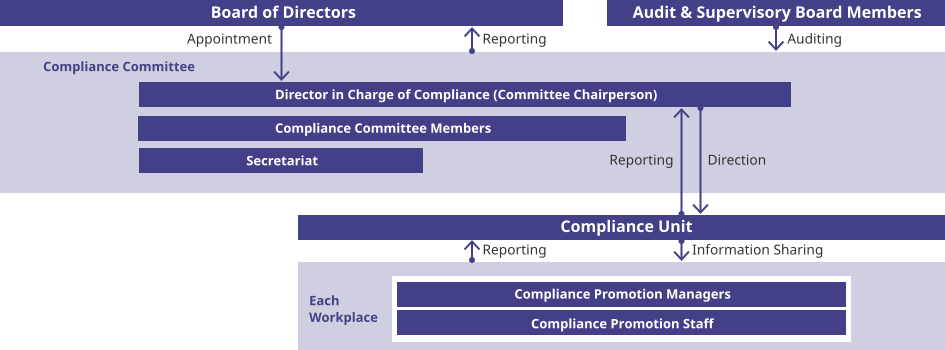
As ongoing initiatives to enhance collaboration in compliance across the Group, we also regularly share information and exchange views on compliance activities with our overseas sites, including subsidiaries in Perth, Jakarta, and Oslo, and provide support for compliance training at our domestic and overseas subsidiaries.
Establishment of the Business Principles and Code of Conduct
In line with the Sustainability Principles, we have established the Business Principles, which must be observed by all officers and employees without exception in the performance of their duties, as well as the Code of Conduct for implementing the Business Principles, and we work to raise awareness of the Code of Conduct among officers and employees. Furthermore, the Audit Unit checks the status of compliance with the Code of Conduct in its annual assessment of internal controls, and the status of mechanisms and structures for timely and appropriate corrective action in the event of non-compliant conduct being discovered. If conduct that does not comply with the Code of Conduct is discovered in internal audits, the Audit Unit issues improvement instructions and each responsible division or site implements the necessary measures.
In addition, the Board of Directors and Compliance Committee undertake continuous monitoring to revise the Business Principles and Code of Conduct according to changes in the business environments, laws, and regulations.
Establishment and Operation of the Whistleblowing System
We operate the whistleblowing system in accordance with the 2022 revision of the Whistleblower Protection Act to accept reports and consultations from officers and employees of the Group. In the system, we have a helpline as the whistleblowing contact point for receiving compliance-related reports and consultations, including legal violations, violations of internal regulations, and other unethical conduct. We also have the INPEX Global Hotline for receiving reports and consultations in three areas where the effects of compliance violations on management are particularly significant. The three areas are bribery and corruption, violation of the Antimonopoly Act, and improper accounting practices. The helpline has internal and external (law firm) contact points, while the INPEX Global Hotline is wholly administered by an external service provider. Reporting and consulting can be completed anonymously.
Response to Whistleblower Reports
Whistleblowing Structure
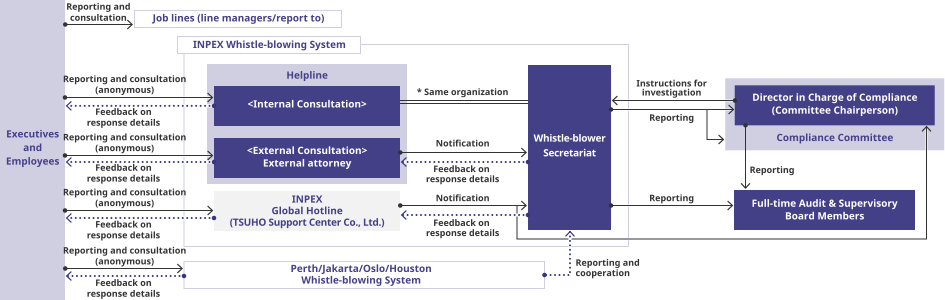
In accordance with the whistleblowing rules, the Compliance Unit, which serves as the internal whistleblowing contact point, or the external lawer, which serves as the external whistleblowing contact point, notify the whistleblower within 20 days of receiving a report whether a factual investigation will be commenced or, for justifiable reasons, will not be commenced. We ensure thorough protection for whistleblowers, including by prohibiting any disadvantageous treatment on the grounds of a report. The Director in charge of compliance cooperates with relevant divisions, as necessary, to conduct investigations. If harassment or other compliance violations are identified, corrective action, including disciplinary sanctions as stipulated in rules of employment and other internal regulations, and recurrence prevention measures, including training and internal awareness-raising activities are taken. In addition, under the internal whistleblowing rules, all officers and employees involved in a reported matter are prohibited from disclosing any information relating to it, and due consideration is given to the protection of privacy.
In addition, the details of reports are promptly reported to the Full-time Audit & Supervisory Board Members, and the results of factual investigations and details of measures are also reported to them in a timely manner, to ensure the whistleblowing system functions more effectively.
During FY2025, the whistleblowing contact point received four internal and four external whistleblowing reports and consultations. Of these, four were related to suspected human rights, discrimination, and harassment violations, two were related to labor management, and two were related to other matters. None of the reported cases were subject to disciplinary sanctions as stipulated in the Code of Conduct. Please refer to Performance Data for details on the number of reports and consultations for each country.
ABC Initiatives
Anti-bribery and anti-corruption (ABC) laws and regulations are becoming increasingly stringent. As a global group operating in approximately 20 countries worldwide, we recognize the importance of a zero-tolerance policy toward bribery and corruption. Accordingly, all officers and employees are required to always act with high ethical standards based on integrity, which is one of the INPEX Values shared across the Group. These values are also integrated as a component of the competency framework used for assessing work behavior in our personnel evaluations.
In addition to requiring compliance with the ABC laws and regulations in the countries in which we operate, the Business Principles and Code of Conduct stipulate the establishment of sound and appropriate relationships with governments and administrative authorities. They also prohibit political donations and facilitation payments, except where legally permitted. We have participated in the United Nations Global Compact since FY2011 and have made clear our stance toward preventing corruption.
In addition to establishing the INPEX Group Global Anti-Bribery and Anti-Corruption (ABC) Policy in FY2019 as a clear and comprehensive statement of our position on ABC and disclosing the policy on our website, we have also formulated ABC policies and procedures as part of our internal regulations. We make revisions as necessary, taking into consideration factors such as changes in the business environment and the initiatives of other companies.
As detailed in the section on our Compliance Structure, disciplinary sanctions may also be taken in accordance with the rules of employment and other internal regulations if violations of the ABC policies and such are confirmed.
In our internal regulations, we have established rules on the approval procedures and proper recording of gifts and entertainment as well as donations and other social contributions. We also have mechanisms for monitoring various procedures from the perspective of ABC.
We conduct appropriate and necessary due diligence, depending on the level of ABC risk, when engaging in transactions with new business partners, including contractors and agents, and include ABC clauses in each contract. In FY2025, approximately 180 cases of due diligence were conducted in Japan.
Since FY2015, we have been regularly conducting risk assessments in Japan and overseas to identify potential risks related to ABC. We implement improvements based on the results of those assessments to strengthen our ABC structure and its operation. In FY2025, we conducted risk assessments at three subsidiaries in Japan, and at our subsidiary conducting business in Kazakhstan. No significant violations or risks related to ABC were identified at any of these sites.
Initiatives to Improve Transparency through the EITI
Since FY2012, we have been participating in and supporting the efforts of the Extractive Industries Transparency Initiative (EITI). This multinational initiative aims to improve the transparency and sound management of the flow of funds from extractive industries to the governments of resource-producing countries. As of December 2025, 55 resource-producing countries and many supporting countries including Japan, companies in extractive industries, and NGOs were participating in the EITI. We provide the EITI with relevant data on participating countries in which we operate projects.
Promotion of Compliance Awareness and Education and Training Programs
We regularly conduct training by business theme and job level, including sessions on the prevention of harassment and discrimination as well as ABC, for our employees. These sessions use examples of past incidents within the Group to strengthen employees' compliance awareness, reduce the risk of harassment and misconduct, and prevent compliance violations. Particularly, in FY2025, to improve communication within organizations, with the assistance of external lecturers, we conducted interactive compliance training—including opinion exchange, group discussions, and case studies— delivered to employees from different job levels and departments. Our main training programs in FY2025 are detailed below. Please refer to Performance Data for details on training held in each country.
| Programs | Target Participants | Topics |
|---|---|---|
| Compliance training for new graduates and mid-career employees | New graduates and mid-career employees (including contract, dispatched, and part-time employees) |
Compliance in general, including harassment prevention and ABC |
| Compliance training by job level | New managerial employees | (1) Raising awareness of harassment prevention based on past cases, (2) initiatives to reduce risks such as harassment and misconduct |
| Compliance training by site | Officers and employees (sites in Japan and subsidiaries conducting business in Japan) |
(1) Harassment prevention, (2) communication within the workplace |
| Compliance training for Managerial Employees | managerial employees (sites in Japan, except the head office and the Technical Research Center) | (1) Harassment prevention, (2) communication within the workplace |
| Compliance training for employees from different job levels and departments | Employees selected from different job levels and departments within the head office | (1) Difference between guidance and power harassment, (2) communication within the workplace |
| Compliance training for officers | President & CEO, Executive Officers, and Full-time Audit & Supervisory Board Members | (1) Scandal prevention and response (with tabletop exercises), (2) revisions to the Whistleblower Protection Act |
| ABC training (1) | Officers and employees (3 subsidiaries in Japan and 1 subsidiary conducting business in Kazakhstan) |
(1) Bribery cases at other companies, (2) our ABC rules in general, including ABC policies and procedures |
| ABC training (2) | New head of overseas offices | (1) Bribery cases at other companies, (2) our ABC rules in general, including ABC policies and procedures |
| ABC training (3) | Officers, employees, and contractors (subsidiaries conducting business in Indonesia) |
Raising awareness of anti-bribery management system |
| ABC training (4) | Officers and employees (subsidiaries conducting business in Australia) |
ABC rules in general: (1) ABC-related laws and regulations, (2) guidance regarding ABC rules |
In addition, we conduct annual internal surveys to identify potential risks regarding harassment and misconduct. We also implement various measures to promote compliance, including the monthly publication of internal newsletters in Japanese and English covering various compliance-related topics such as harassment and anti-bribery and corruption (ABC), with the aim of enhancing compliance knowledge and awareness among all officers and employees.
Related Page
-
Sustainability Structure
-
Progress of Action Plans for each Materiality
-
Respect for Human Rights
-
Response to Feedback from Stakeholders