
INPEX's basic approach to sustainability management is to promote both a stable supply of energy and energy transition initiatives, while addressing climate change and other sustainability issues through its business and value chains. Following this approach, we practice sustainability management focusing on the sustainability-related materiality of greatest importance to us and our stakeholders.
Governance
Organizational Structure
Our governance structure for promoting sustainability is detailed below.
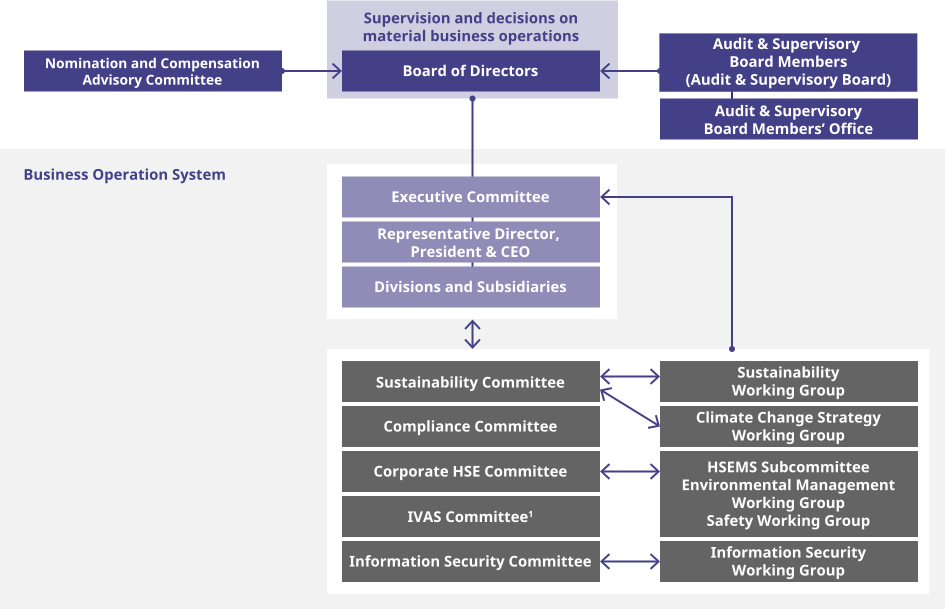
As of April 1, 2026
-
1The INPEX Value Assurance System (IVAS) Committee supports our decision-making process related to the advancement and value enhancement of our projects. Please refer to IVAS Committee for details.
Board Supervision of Sustainability-related Issues
The Board of Directors serves as the supervisory body that is responsible for management strategies to address sustainability-related risks and opportunities across the INPEX Group, as well as efforts to enhance medium- to long-term corporate value. The Board is positioned to supervise key sustainability issues for the Group. Board members possess skills in the field of sustainability. Please refer to Director and Audit & Supervisory Board Member Skill Matrix under the heading of Corporate Governance for details.
To improve the level of knowledge among members of the Board, we provide lectures and opinion exchange meetings with external experts to deepen their knowledge of global trends and issues in sustainability.
The Board regularly discusses agenda items related to sustainability risks and opportunities from multiple perspectives, including global trends and trade-offs with business operations. In FY2025, sustainability was discussed at 13 of the 15 Board meetings.
Sustainability-related targets are reported to the Board once a year. We have also adopted targets with particularly high materiality as KPIs for the compensation of Representative Directors and other Directors (excluding Outside Directors). For bonuses, which serve as short-term incentives, we have adopted safety metrics (zero major incidents*1) as a KPI for Directors (excluding Outside Directors). For stock-based compensation, which serves as a medium- to long-term incentive, we have adopted net carbon intensity as a KPI for Directors (excluding Outside Directors and non-residents of Japan) and Executive Officers (excluding non-residents of Japan). The management metrics are detailed below.
| Bonus KPIs | Evaluation Weight | |
|---|---|---|
| Financial metrics | Net income | 45% |
| Cash flows from operating activities before exploration | 45% | |
| Non-financial metrics | Safety metrics (zero major incidents) | 10% |
| Stock-based Compensation KPIs | Evaluation Weight | |
|---|---|---|
| Financial metrics | Net income | 30% |
| Cash flows from operating activities before exploration | 30% | |
| ROE | 10% | |
| ROIC | 10% | |
| Total payout ratio | 10% | |
| Non-financial metric | Net carbon intensity | 10% |
-
*1Fatalities, serious injuries, and Tier 1 process safety event
Business Execution Structure
Executive Committee
From the viewpoint of expediting decision-making with respect to business execution decisions, including those related to sustainability, we have established the Executive Committee to facilitate agile decision-making for matters that are not required to be resolved by the Board of Directors and to hold discussions that can contribute to decision-making by the Board. The Executive Committee meetings are held once a week and as necessary. The Executive Committee is composed of full-time Directors, Executive Officers who are Senior Vice Presidents of various divisions, and other Executive Officers who are deemed necessary by the Committee Chair and appointed by resolution of the Executive Committee. The Executive Committee is chaired by the Representative Director, President & CEO.
Representative Director, President & CEO, Divisions, and Subsidiaries
The Representative Director, President & CEO represents the Group and is responsible for business execution, including the Group's sustainability. Executive Officers, as either Senior Vice Presidents or officers in charge, execute business for the specific divisions and subsidiaries to which they are appointed. Each business executive appointed to specific divisions and subsidiaries manages the progress of measures and initiatives for sustainability and reports the results to the Executive Committee.
Sustainability Committee
We established the Sustainability Committee to fulfill the Group's social responsibilities and promote initiatives that contribute to the sustainable development of society. Chaired by the Representative Director, President & CEO, the Sustainability Committee comprises the Representative Director, Senior Executive Vice President of the General Administration Division, Senior Executive Vice President of the Corporate Strategy & Planning Division, Chair of the Compliance Committee and Chair of the Corporate HSE Committee. Matters discussed by the Sustainability Committee are also resolved and reported by the Executive Committee and the Board of Directors. The Sustainability Committee deliberates on basic policies and material matters related to sustainability and its implementation. Under the Sustainability Committee, we have established the Sustainability Working Group and the Climate Change Strategy Working Group, which comprise operational-level members from various divisions to support a Group-wide consultation structure.
Key Agenda Items
- Sustainability management results and policy on initiatives
- INPEX Group's materiality
- Revision of the Corporate Position on Climate Change
- Assessment of climate change-related risks and opportunities
- Status of response to human rights issues and future initiatives
- Governance and management of non-financial information
- Plan of social contribution activities
Other Committees Related to Business Execution
In addition to the Sustainability Committee, we have established the Compliance Committee, the Corporate HSE Committee, the Information Security Committee, and INPEX Value Assurance System (IVAS) Committee to promote various measures. Overviews of each committee and the activities they conducted in FY2025 are detailed below.
1. Compliance Committee
We have established the Compliance Committee to promote consistent compliance activities across the Group. Chaired by the Executive Officer in charge of compliance, the Compliance Committee comprises the Senior Executive Vice President of the General Administration Division, Senior Executive Vice President of the Corporate Strategy & Planning Division, Executive Vice President of the Finance & Accounting Division, Executive Vice President of Technical Headquarters, Senior Vice President of the Domestic Projects Division, Executive Officer in charge of HSE, Head of Overseas Projects, General Counsel of the Legal Unit, General Manager of the DE&I Unit, external attorneys and members appointed by the Executive Officer in charge of compliance. The Compliance Committee formulates and monitors implementation of compliance-related basic policies and measures for the Group, formulates annual action plans, resolves material matters, and manages the implementation status of compliance activities. The Compliance Committee met 8 times in FY2025. Furthermore, to ensure coordination between the Compliance Committee and the workplace, compliance promotion personnel and managers are assigned to each workplace. The Compliance Unit, which serves as the secretariat of the Compliance Committee, regularly holds liaison meetings with compliance promotion personnel to enhance and solidify their awareness of compliance.
2. Corporate HSE Committee
Chaired by the Executive Officer in charge of HSE, the Corporate HSE Committee comprises the Senior Vice Presidents and officers of the standing organizational units and deliberates on the Group's basic policies and material matters related to HSE management. Specifically, the Corporate HSE Committee deliberates on medium-term plans, objectives, and programs for HSE to be addressed across the Group, understanding and assessing of the situation through HSE audits, and maintenance, review, and improvement of the HSE management system. The Executive Officer in charge of HSE also ensures the necessary corrective and review actions are reflected in medium- to long-term objectives, programs, and other initiatives through management reviews. Material matters deliberated by the Corporate HSE Committee are resolved by the Executive Committee and then resolved or reported by the Board of Directors. The Corporate HSE Committee met four times in FY2025 to resolve and report on HSE objectives, analysis of causes and trends in major incidents and incidents resulting in injury in the previous fiscal year, HSE performance for the first half of this fiscal year, and progress on HSE management measures.
In addition, under the Committee, we have established the Environmental Management Working Group and the Safety Working Group, both of which comprise operational-level members from various divisions to support a Group-wide consultation structure. In FY2025, the Environmental Management Working Group met once or twice with each operational organization to discuss responses to the Taskforce on Nature-related Financial Disclosures (TNFD), treatment of waste, and methane emission management. The Safety Working Group met 15 times to discuss safety-related issues across the Group and ways to improve safety performance. As a result, we built a shared understanding of how to identify the underlying factors behind incidents and approaches to analysis. We also organized how to better use incident-related information, strengthening the foundation for improving safety performance.
-
*2Taskforce on Nature-related Financial Disclosures
3. Information Security Committee
We have established the Information Security Committee to consider and make decisions regarding measures necessary for maintaining, managing, and strengthening information security. The Information Security Committee, chaired by the Executive Vice President of Technical Headquarters, who serves as the Chief Information Security Officer, deliberates on basic policies and material matters related to information security, and manages our response to information security incidents and recurrence prevention measures. The Information Security Committee met twice in FY2025.
4. IVAS Committee
We have established the INPEX Value Assurance System (IVAS) Committee to confirm the status of preparations at important milestones of major projects in which we participate, and to contribute to our decision-making process for promoting and improving the value of the projects. Chaired by the Executive Vice President of Technical Headquarters, the IVAS Committee conducts cross-organizational technical assessments for new project acquisitions and for existing projects in each phase of exploration, appraisal, and development. The IVAS Committee met 16 times in FY2025.
Strategy
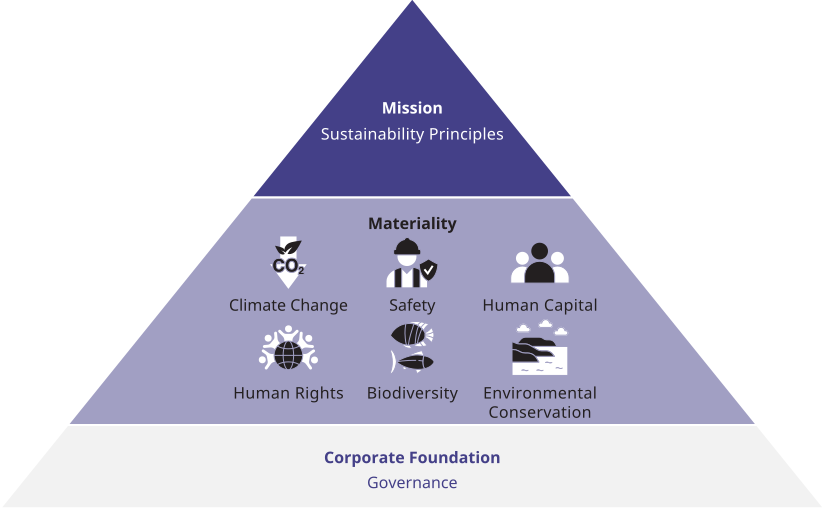
We defined our Sustainability Principles, based on our Mission, and identified the sustainability-related materiality of greatest importance to the Group and its stakeholders. We identified the Group's materiality by considering the financial effects the environment and society have on the Group, and the Group's impacts on the environment and society. Of the six identified materiality items, we selected Climate Change, Safety, and Human Capital as items of financial materiality due to the significant financial effects the environment and society have on the Group. We also established action plans for the Group's priority issues for each materiality item, incorporating these plans into the PDCA cycle of each department in the Group, and we are working toward continuous improvement.
INPEX's Materiality and Action Plans
The Group's materiality and action plans for each materiality item are shown in the table below.
| Materiality | Action Plans |
|---|---|
| Climate Change | Achievement of targets for addressing climate change |
| Expansion of natural gas and LNG business | |
| Implementation of lower-carbon solutions | |
| Expansion of businesses in power-related fields | |
| Safety | Prevention of major incidents |
| Securing of occupational health and safety | |
| Human Capital | Enhancement of engagement and promotion of DE&I |
| Human Rights | Respect for human rights |
| Coexistence with, and development of, local communities (indigenous peoples) | |
| Supply chain risk management | |
| Biodiversity | Biodiversity conservation |
| Environmental Pollution Measures | Implementation of environmental pollution measures |
We also incorporated the action plans into our PDCA cycles to enable continuous improvement. Governance is a very essential element in corporate management, decision-making, and risk management. We also consider a strong governance structure to be a material element for supporting our materiality initiatives and realizing our sustainable growth.
For this reason, we established three action plans—improvement of our corporate governance structure, improvement of our risk management structure, and compliance with laws and regulation, prevention of bribery and corruption—as specific initiatives for maintaining and enhancing our governance structure. Group's progress on each action plan is detailed in Progress of Action Plans for each Materiality.
Materiality Assessment Process
The assessment process is detailed below.
1. Understanding of INPEX's Value Chain and Businesses
We reviewed our value chain and stakeholders through the following publications and internal documents.
- Annual Securities Report
- INPEX Vision 2035
- Results of past materiality assessments
- Policies related to sustainability
- Results of human rights due diligence assessments
- Results of stakeholder engagement
2. Preparation of the Topic List
We extracted potential issues relevant to the Group, referencing various reporting guidelines below, and created a topic list.
- GRI (Global Reporting Initiative) Standards
- ESRS (European Sustainability Reporting Standards)
- SASB (Sustainability Accounting Standards Board) Standards: Oil & Gas - Exploration & Production
- ISSB (International Sustainability Standards Board) Standards
- Task Force on Climate-related Financial Disclosures (TCFD) recommendations
- Taskforce on Nature-related Financial Disclosures (TNFD) recommendations
- Ipieca Sustainability reporting guidance for the oil and gas industry
- Disclosure documents from other companies in the same industry
3. Definition of IRO
We compared each issue against the Group's value chain and businesses, and defined impacts, risks, and opportunities (IRO) that could occur over the short, medium, and long terms.
4. Setting of Assessment Criteria and Scoring
We identified the Group's materiality by considering the financial effects the environment and society have on the Group, and the Group's impacts on the environment and society. Specifically, we assessed sustainability-related risks and opportunities that affect the Group's financial outlook in terms of the likelihood and magnitude of the financial effects. We also assessed the impacts of the Group's business activities on the environment and society in terms of the likelihood and severity of the impacts. We set the likelihood assessment axis with reference to country-specific and business-specific ratings, including the past number of incidents in the Group and other companies in the same industry.
5. Stakeholder Engagement
We conducted surveys and interviews with internal and external stakeholders to confirm their expectations and concerns related to issues the Group should address. Stakeholders include all officers and employees of the Group, investors, and other companies in the same industry.
As a result, we found that our internal assessment of the Group's material issues and the views of external stakeholders are aligned.
6. Identification of Priority Issues
Based on scores calculated through "Setting of Assessment Criteria and Scoring," we conducted mapping and identified our materiality as the material issues we need to address as a priority.
The identified materiality items were assessed by each department in accordance with the Group's risk management process, and discussed by the Sustainability Working Group.
7. Management Review
Our materiality was resolved by the Sustainability Committee and Executive Committee, as the main committees within our sustainability structure, and then reported to the Board of Directors. We review and identify our materiality every year.
Sustainability-related Risks and Opportunities
We strive to continuously improve our risk management structure, which is designed to appropriately identify and manage the risks associated with our business operations, including sustainability-related risks. We have established a structure to prevent, or otherwise mitigate, adverse impacts. This helps us to maintain and reinforce the trust of our customers, business partners, investors, and other stakeholders, and maximize our corporate value. Please refer to Risk Management Structure under the heading of Governance for details on our risk management process. Please also refer to the explanations of each materiality for details on individual risks and opportunities, as well as metrics and targets.
Trade-offs between Risks and Opportunities
At the Group, we work to reduce trade-offs in our items of financial materiality by conducting meetings of the IVAS Committee, which performs cross-organizational technical assessments as well as environmental and social impact assessments at each phase of our businesses (upstream oil and natural gas business, renewable energy business, and CCS/hydrogen business), and by regularly performing economic and risk assessments for each business.
Time Horizons
We define the time horizons over which the impacts of risks and opportunities could reasonably be expected to occur in line with our Medium-term Business Plan, which is the planning period the Group uses for strategic decision-making, as follows: short-term is less than one year, medium-term is one to less than three years, and long-term is three years or more.
Resilience
INPEX Vision 2035, which we announced in February 2025, outlines the Group's long-term strategy toward 2035, taking into account recent changes in the management environment, social conditions, and other situations. We review the highly uncertain risks that could affect the achievement of INPEX Vision 2035 every year. We also apply the results of our resilience assessments to the formulation of our strategies and adjustment of our business model. Please refer to Climate Resilience for details on climate resilience, which has a significant effect on our outlook.
Related Page
-
Editorial Policy
-
Message from the President & CEO
-
Progress of Action Plans for each Materiality
-
Metrics, Targets, and Results