
Governance
INPEX's governance structure for climate change is detailed in Sustainability Structure under the heading of Governance.
Strategy
Policy
We published our Corporate Position on Climate Change in December 2015. Subsequently, to support countries' efforts toward achieving the goals of the Paris Agreement, we established a target in January 2021 to achieve net zero in our emissions by FY2050 (Scope 1 and Scope 2). With changes in the external environment as well as the updating of our Long-term Strategy and Medium-term Business Plan, we have reviewed our policies and targets for achieving net zero in our emissions by FY2050. In February 2025, together with the announcement of INPEX Vision 2035, we revised our Corporate Position on Climate Change.
Our disclosures related to climate change response are in line with the recommendations of the Task Force on Climate-related Financial Disclosures (TCFD). We support the Japanese government's laws and regulations (Act on Rationalization of Energy Use and Shift to Non-fossil Energy, Act on Promotion of Global Warming Countermeasures, etc.) and a range of policies related to climate change, and incorporate them into our policies and business strategies. In Japan, our primary base, we are active participants in the government-endorsed GX League. We engage in the emissions trading system (GX-ETS) and rules for market creation, demonstrating our leadership and commitment toward achieving net zero.
Corporate Position on Climate Change
-
1.We will continue to meet the increasing energy demands of Japan and the world, fulfilling our responsibility for energy development and stable supply over the long term. At the same time, we will actively work towards transforming the energy structure to achieve a net zero by 2050.
-
2.To contribute to the realization of the Paris Agreement goals on climate change, we will set climate change response targets challenging for net zero emissions by 2050.
-
3.We will promote lower-carbon initiatives to meet societal needs toward net zero. Concrete measures include supplying natural gas as a "pragmatic transition fuel" in a cleaner manner. Additionally, we will provide lower-carbon solutions such as CCS and blue hydrogen/ammonia to third parties while strengthening new initiatives in power-related fields.
Risks and Opportunities
We assess the INPEX Group's climate-related risks and opportunities every year. The results of our assessment are detailed below.
Assessment of Climate Change-related Risks and Opportunities at the End of FY2025
(Short-term: Less than 1 year; medium-term: 1 to less than 3 years; long-term: 3 years or more)
Transition Risks
| Risk Categories | Risk Description | Expected Timing of Risk Occurrence | Measures |
|---|---|---|---|
| Policies, laws, and regulations | Risk of increasing direct costs for Scope 1 and Scope 2 emissions due to introduction and strengthening of carbon pricing systems, methane emission control regulations, environmental laws and regulations, and other such frameworks as society transitions to the Net Zero Emissions by 2050 Scenario (NZE Scenario) of the International Energy Agency (IEA), and the countries and regions where projects are located strengthen their climate change measures | Short-term-long-term |
|
| Policies, laws, and regulations | Risk of climate-related lawsuits in pursuing oil and gas business | Short-term-long-term |
|
| Technologies and markets | Risk of further delays in commercializing our CCS and hydrogen businesses even though society has transitioned to the NZE Scenario | Medium-term-long-term |
|
| Markets | Risk of adverse effects on funding as investors or financial institutions consider our business activities, efforts to reduce GHG emissions, or information disclosure to be inadequate | Short-term-medium-term |
|
| Markets | Risk of lower demand for oil and gas due to a preference for low-carbon energy options, such as renewable energy and electric vehicles | Long-term |
|
| Reputation | Risk of poorer reputation regarding the Group's climate change responses due to lack of absolute Scope 1 and Scope 2 emissions targets | Short-term-long-term |
|
| Reputation | Risk of poorer reputation regarding the Group's climate change responses due to lack of Scope 3 emission reduction targets | Short-term-long-term |
|
Physical Risks
| Risk Categories | Risk Description | Expected Timing of Risk Occurrence | Measures |
|---|---|---|---|
| Acute | Risk of adverse effects on operations due to extreme weather phenomena | Short-term |
|
| Chronic | Risk of adverse effects on operational facilities due to the long-term increases in average temperature, changes in rainfall patterns, and sea level rise | Medium-term-long-term |
|
Opportunities
| Opportunity Categories | Opportunity Description | Expected Timing of Opportunity Occurrence | Progress |
|---|---|---|---|
| Resource efficiency | Improvements to energy efficiency in production processes | Short-term |
|
| Energy sources | Use of renewable energy sources in production processes | Medium-term-long-term |
|
| Long-term |
|
||
| Products and services | Natural gas and LNG | Long-term |
|
| CCS and hydrogen | Long-term |
|
|
| Power-related | Short-term-long-term |
|
|
| Subsurface resources other than oil and natural gas | Medium-term |
|
|
| Markets | Access to new markets | Short-term |
|
| Medium-term |
|
Climate Resilience
Climate-related Scenario Analysis
We conduct analysis using several scenarios due to the high uncertainty of climate change risks and opportunities. In considering the outlook for the business environment, including energy demand and supply to realize a low-carbon society by 2050*1, we refer to scenarios such as the Stated Policies Scenario (STEPS) and NZE Scenario in the World Energy Outlook (WEO) published by the IEA. From these scenarios, we assess the transition and physical risks in our business. INPEX Vision 2035, our long-term strategy, was developed in February 2025 based on analysis using these scenarios. We will continue to identify changes in the business environment using several scenarios, and review management strategies and plans in line with societal trends.
-
*1The IEA WEO sets out an outlook on the global energy situation through 2050.
Transition Risk Assessment
We use the scenarios in WEO and the following two methods to financially assess the transition risks of the Group.
The first method is to conduct economic assessments of our projects using our internal carbon price. We employ our internal carbon prices in the base case of our economic assessments, given that more than 150 countries and regions have already declared net zero targets by 2050 and laws and regulations to introduce carbon pricing are expected to be adopted in a growing number of countries as policies to tackle climate change are strengthened. Through codifying the application of the internal carbon prices in the base case, the costs incurred for GHG emissions are recognized internally as an important factor in business investment. We also show our stakeholders that the Group is making management decisions after considering the transition risks. Each year, we update our internal carbon prices—used in financial effect assessment—with reference to the carbon prices in the WEO. If there is a carbon price system in the country in which we operate projects, we reference the Group's estimated price based on factors such as estimates provided by external experts. If there is no carbon price system, we determine prices after verifying their appropriateness against the assumptions in the STEPS. In FY2025, we adopted the STEPS Korea prices of WEO 2024, and for FY2026, we continue to set prices with reference to the STEPS Korea prices of WEO 2025 (2035: US$52/ton-CO2e; 2040: US$62/ton-CO2e; 2050: US$75/ton-CO2e).
The second method is to conduct resilience assessments of the Group's business portfolio. This is an assessment of the effects on our portfolio from the oil and carbon prices in the scenarios given by the IEA. As of FY2025, we referenced WEO 2024 and applied the oil and carbon prices in the STEPS, Announced Pledges Scenario (APS), and NZE Scenario to the net present value (NPV) calculation for projects, and calculated the percentage of change from the book value to assess the effects on our portfolio. In the assessment for FY2026, we plan to reference WEO 2025 and assess using the STEPS and NZE Scenario.
We will continue to refine the implementation standards for this method while factoring in changes in the business environment to improve the competitiveness of the Group's business portfolio.
Two Approaches to Assessment of Financial Effects of Transition Risks
| Economic Evaluation of Projects | Portfolio Resilience Assessments | |
|---|---|---|
| Assessment method | Economic assessment of projects using internal carbon prices |
Assessment of the financial effect based on oil and carbon prices under the following scenarios (as of FY2025, referencing WEO 2024)
|
| Metric | IRR based on internal carbon prices (base case) | Percentage of change from book value based on application of the above metric price |
Assessment of Resilience to Physical Risks
We assess the resilience of the Group's assets to physical risks, analyzing them as either acute risks or chronic risks. In FY2018, we reviewed the process for assessing physical risks, then developed a roadmap and started assessing physical risks at the Ichthys LNG Project and our domestic assets in Niigata Prefecture, as major operator projects. Together, they account for 100% of our insurance coverage of domestic and overseas operator projects in operation. Subsequently, we reassessed physical risks at the Naoetsu LNG Terminal, one of the Group's major facilities, following a revision of a report that informs our assessments. This report is an assessment report issued by the Japan Meteorological Agency on observations and projections. The Representative Concentration Pathways 8.5 (RCP 8.5) scenario, discussed in this report, predicts an average sea level rise of approximately 0.19 m. Our assessment showed that this facility structure can withstand a sea level rise of that magnitude. We also hire an external assessment service to calculate the costs of direct and indirect damage to our domestic assets caused by potential riverine flooding and storm surges. As a result, we confirmed that the projected damage as of FY2030 and FY2050 would be limited for the top 10 sites in Japan (plants, gas pipelines, and major subsidiary offices) covered by our comprehensive corporate indemnity insurance. For all these physical risk assessments, we used the same metrics, such as mid-21st century average temperature rises and sea level rise, in the RCP 8.5 scenario outlined in the Intergovernmental Panel on Climate Change (IPCC) Fifth Assessment Report.
For chronic risks, the assessments indicate a low risk from floods at the Ichthys LNG Project and other major facilities located on the seaboard because they have been designed to withstand rising sea levels. Future temperature increases could conceivably impair operating efficiency, but because we conduct ongoing improvements and maintenance to the facilities as required, we have concluded that no major damage is likely to occur through FY2030. For acute risks, we strive to ensure that our major operator projects are adequately prepared for typhoons, cyclones, and other extreme weather phenomena through appropriate planning, operational measures, training, and use of external information. At the LNG receiving jetty at the Naoetsu LNG Terminal, one of the Group's major facilities, we have installed an interconnection line linking to the neighboring power station. This setup ensures continuity in operations in the event of damage to our own facilities, enabling us to continue to receive LNG via the jetty at the power station. Insuring the Group's major facilities against natural disasters is another way we strive to reduce financial losses associated with acute risks. We also assessed risks to our gas pipeline from natural disasters in Japan and considered countermeasures, and, based on that assessment, we carried out replacement work on sections of the pipeline deemed to have a high natural disaster risk.
In the Hazard Identification (HAZID) guidelines, a HSE management system document, the Group has included the impacts of climate change as one of the guidewords for HAZID workshops. We are incorporating physical risk assessments into our risk management approach across all life cycles of business activities, including new projects. Cross-organizational teams will continue to conduct periodic physical risk assessments and make appropriate disclosures. Simultaneously, we aim to diversify our analysis methods to conduct more comprehensive assessments.
Approach to Assessment of Resilience to Physical Risks
| Asset Assessment | |
|---|---|
| Assessment method | Assessment of physical risks—as either acute risks or chronic risks—of assets for each project |
Climate Transition Plan
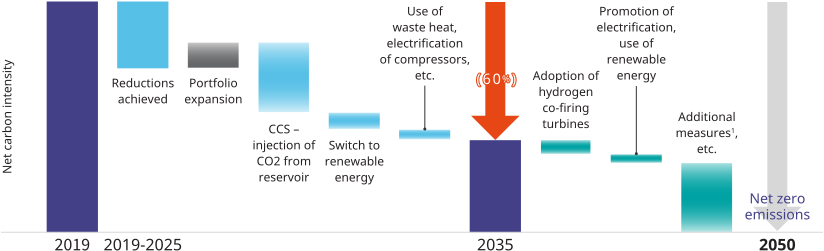
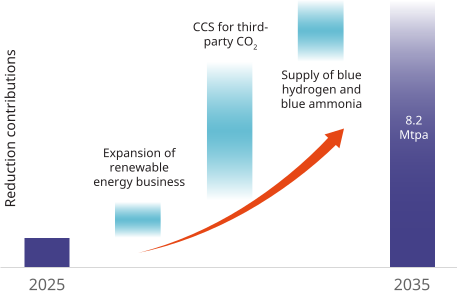
Based on the INPEX Vision 2035, the Medium-Term Business Plan, and the aforementioned scenario analysis, we use the marginal abatement cost (MAC) curve*2 to develop our roadmap to achieve decarbonization of the Group's businesses. From FY2019—the base year—to FY2025, we have been steadily reducing our net carbon intensity through GHG reduction activities, such as upgrading to energy-saving facilities and managing methane emissions. While our net carbon intensity will increase in the future due to expansion in parts of our portfolio, we aim to systematically bring down net carbon intensity by 60% (compared to the base year) by FY2035 using measures such as reducing CO2 emissions during oil and gas production through installation of CCS at our production facilities in Australia and other locations, and switching to renewable energy for our power requirements. From FY2035, we aim to achieve net zero emissions by FY2050 through adoption of the optimal reduction measures according to technological progress, such as adopting hydrogen combustion turbines at power generation facilities, advancement of electrification, and further use of renewable energy. In addition to reducing our emissions, we also work on realizing a lower-carbon society. We set avoided emissions targets that contribute to realizing a lower-carbon society, and we will work toward them after strictly assessing the profitability of individual projects, taking into consideration the use of government support in each country.
-
*2The MAC curve represents individual abatement measures by illustrating the reduction potential (the expected reduction amount from implementing the measure) and the abatement cost (the cost required to reduce one ton of CO2). The measures are arranged in order of increasing abatement cost, showing the reduction potential of each measure.
Roadmap to Achieve Decarbonization of INPEX Business by FY2050
-
1We will further adopt optimal reduction measures according to technological progress.
Roadmap to Contribute to a Low Carbon Society
Related Page
-
Climate Change>Risk Management
-
Climate Change>Metrics, Targets, and Results
-
Climate Change>Efforts to Reduce GHG Emissions
-
Climate Change>Energy Transition