
To reduce GHG emissions, we implement energy-saving and emission optimization efforts tailored to the site's circumstances and avoid continuous flaring and venting during routine operations at the Group's operator projects. In addition to mainly using clean power at our head office and onshore facilities, we are working with Abu Dhabi National Oil Company (ADNOC) to adopt clean power, including using onshore clean power to supply offshore facility power needs.
Efforts to Use Energy Efficiently in Japan
In Japan, we are rationalizing the use of energy according to the Act on Rationalization of Energy Use and Shift to Non-fossil Energy and the Act on Promotion of Global Warming Countermeasures. Based on Japan's laws and regulations, we report on energy consumption, the status of other energy use, and studies and efforts related to the rationalization of energy use in the business activities of our operational organizations.
Regarding the Act on Rationalization of Energy Use and Shift to Non-fossil Energy, we have set ourselves the target of reducing average energy consumption intensity by 1% or more per year over five years. We have also developed a medium- to long-term plan to achieve this target, and we assess our progress each year and report to the Ministry of Economy, Trade and Industry.
Research and Studies for Saving Energy
At the Naoetsu LNG Terminal, we reviewed the value of the LNG pump minimum flow setting to limit the generation of boil-off gas (BOG)*1 in LNG tanks and reduce the power consumption of BOG compressors. We also introduced LED lighting at the Nagaoka Field Office to reduce power consumption.
-
*1BOG is gas that evaporates due to natural heat ingress from the external environment when cryogenic liquids such as LPG and LNG are transported or stored.
Education and Training to Improve Energy Efficiency
Regarding the rationalization of energy use, we appoint energy management planning promoters and energy management assistants to maintain facilities that consume energy and to improve and monitor methods of energy use. Based on the Act on Rationalization of Energy Use and Shift to Non-fossil Energy, energy management planning promoters and energy management assistants have completed legally required training courses related to knowledge and skills necessary for the rationalization of energy use.
Efforts to Reduce Fugitive Methane Emissions
The Group has set a target of maintaining its methane emission intensity at the current low level (approximately 0.1%). In FY2025, our methane emission intensity was 0.04%, which is below our target level.
We have joined the Oil & Gas Methane Partnership 2.0 (OGMP 2.0), a reporting framework for methane emission reductions by oil and gas companies. OGMP 2.0 was established as an international reporting framework under the United Nations Environment Programme (UNEP), providing member companies with a framework for comprehensive, measurement-based reporting to promote methane emission reductions. Since FY2024, we have been reporting methane emission reductions through the OGMP 2.0 framework and have achieved the Gold Standard Pathway, which is given to companies that meet the standards stipulated in OGMP 2.0. Through this reporting, we will ensure the accuracy and transparency of the Group's methane emission reporting, and actively pursue technological innovations and sharing of case studies with other member companies with the aim of measuring and reducing methane emissions.
To manage and reduce methane emissions, we have been collecting and reporting data on fugitive emissions based on international methods since before joining OGMP 2.0.
Starting from FY2019, we have surveyed and identified inspection points for fugitive emissions from equipment and facilities at our projects in Japan, establishing a structure for data collection and reporting. Subsequently, we brought in a laser methane detector to enable inspections at almost all applicable points. We also introduced vehicle-mounted methane detectors and drones with which we inspect all 1,500 km of our gas pipelines in Japan. Fugitive emissions detected through this inspection process are rectified immediately.
We have been carrying out inspections for fugitive methane emissions through an LDAR program using infrared cameras at our overseas projects. At the Ichthys LNG Project, we have been inspecting the central processing facility (CPF) and floating production, storage, and offloading (FPSO) facility since FY2022, and the onshore gas liquefaction plant since FY2023. In FY2025, we also started measuring methane emissions using drones, advancing methane emission management that is more accurate and transparent.
We are exploring the possibility of implementing similar inspections at other projects and will continue to take further action to reduce fugitive methane emissions across the Group.
Efforts to Reduce Flaring
The Group has set a target of zero routine flaring at its operator projects by FY2030, and is examining flare reduction measures through collaboration among relevant departments. Since FY2022, we have also been managing our flare volumes in two categories—routine and non-routine flaring—in accordance with the Flaring Management Guidance for the Oil and Gas Industry developed by Ipieca, the International Association of Oil & Gas Producers (IOGP), and the Global Gas Flaring Reduction Partnership (GGFR). While the share of routine flaring in our total GHG emissions has already been reduced to an extremely low level, we will continue to further reduce it while taking into consideration factors such as economic feasibility.
Approach to Procuring and Utilizing Carbon Credits
Following the mitigation hierarchy approach, the Group seeks to avoid and reduce GHG emissions and to use carbon credits for offsets after such efforts. We plan to use carbon credits certified under highly trusted domestic and international schemes. Therefore, we work to understand the trend of carbon-related regulations in countries where our assets are located. At the same time, we also track the latest developments in the carbon credit market such as initiatives in Japan and overseas and assess the medium- to long-term performance of our projects. Through these efforts, we work to procure high-quality credits. At the Ichthys LNG Project, which is eligible for the Safeguard Mechanism, Australia's emissions trading scheme, it is also possible to use carbon credit offsets after implementing reduction measures to keep GHG emissions from the facility below baseline level. The carbon credits used for compliance with Safeguard Mechanism are verified and issued by the Australian government authority Clean Energy Regulator, and we plan to use Australian carbon credit units (ACCUs) that are recognized to comply with this regulation.
The Group selects and uses carbon credits certified under the schemes shown below.
| Scheme Name | Description |
|---|---|
|
J-Credit Scheme

|
Under the J-Credit Scheme, the Japanese government certifies the amount of greenhouse gas emissions (such as CO2) reduced or removed by sinks through efforts to introduce energy-saving devices and manage forests, as "credit." |
|
Joint Crediting Mechanism (JCM)

|
Japanese Government-led bilateral credit program for reduction and removal of GHG emissions in cooperation with developing countries, with both sides sharing the benefits of reduction and removal |
|
Australian carbon credit units (ACCUs)
|
Australian carbon credits issued by the Clean Energy Regulator, Australian government according to the Carbon Credits (Carbon Farming Initiative) Act 2011 |
|
Verified Carbon Standard (VCS)

|
Verification standard established by Verra, an international body for setting carbon offset standards |
Efforts to Procure High-quality Credits
1. Internal Project Assessments
To ensure acquisition of high-quality carbon credits from top-grade projects, we first assess projects before making a final selection and purchase. These assessments are designed to identify any permanence*2 concerns, potential issues with local communities and other stakeholders, and to verify that land ownership and usage rights are unambiguous and guaranteed to extend beyond the life of the crediting period. We make a comprehensive judgment on projects by considering the results of these internal assessments alongside the results of credit assessments by external assessment companies.
2. Priority on Projects with Co-benefits
In addition to the effectiveness of reducing CO2 emissions and absorbing CO2, we give preference to projects with the Sustainable Development Verified Impact Standard (SD VISta)*3 and Climate, Community & Biodiversity Standards (CCB Standards)*4 that deliver co-benefits by contributing to the United Nations' SDGs
-
*2The concept that refers to the need to ensure that CO2 reduction and absorption volumes are nonreversible, with no risk of release into the atmosphere.
-
*3A framework for certifying a project's contribution to the SDGs.
-
*4A framework for certifying projects that simultaneously deliver tangible climate, community, and biodiversity benefits.
Efforts to Reduce Emissions in Supply Chain—Toward Scope 3 Reduction
Efforts with Contractors and Suppliers
Our HSE Policy states that we will "pursue every effort to manage and reduce Greenhouse Gas (GHG) emissions based on our ‘Corporate Position on Climate Change'." In line with our efforts to reduce emissions across the supply chain, our contractor and supplier agreements include a clause requiring compliance with our HSE Policy. Our Supplier Code of Conduct established in July 2022 sets out our expectation that suppliers undertake voluntary environmental efforts, such as measures to reduce GHG emissions. We also collect information about our suppliers' efforts regarding the reduction of GHG emissions by asking them to answer our CSR self-assessment surveys.
Promotion of Carbon Offset Product Sales
The INPEX Group sells carbon offset products to its customers. So far, the reduction of GHG emissions through such sales has exceeded the equivalent of 2,360 thousand tons-CO2e. Carbon offset products are LNG, natural gas, LPG, and jet fuel sold by the Group whose GHG emissions generated across the life cycle—from extraction through transportation and combustion—are offset by the equivalent amount of carbon credits, resulting in net zero GHG emissions. By supplying these carbon offset products, we contribute to our customers' efforts to reduce their supply chain carbon footprints.
Past Efforts
- FY2018: Published the Corporate Position on Climate Change (since then, regularly reviewed and revised)
- FY2020: Made the Climate Change Strategy Working Group an advisory body to the Sustainability Committee
- FY2021: Established target to achieve net zero in absolute emissions by FY2050 (Scope 1 and Scope 2)
- FY2022: Announced the Long-term Strategy and Medium-term Business Plan (INPEX Vision @2022) and established the five net zero businesses
- FY2023: Joined the OGMP 2.0
- FY2024: Joined the Oil and Gas Decarbonization Charter
- FY2025: Announced INPEX Vision 2035 and revised the Corporate Position on Climate Change (latest version)
Case Study: Promotion of Forest Conservation Targeting Net Zero Emissions
Materiality of Forest Conservation and Afforestation in Tackling Climate Change
We continue to see nature-based solutions—such as forest conservation and afforestation projects—as fulfilling an important role in tackling climate change. The role of forests is not only to reduce CO2 emissions by preventing deforestation and forest degradation and increase CO2 absorption through afforestation, but also to offer co-benefits by safeguarding critical biodiversity, conserving water sources, reducing soil erosion, and raising the living standards of local communities, thereby contributing to achieving the United Nations' Sustainable Development Goals (SDGs).
INPEX Group's Efforts for Forest Conservation and Afforestation
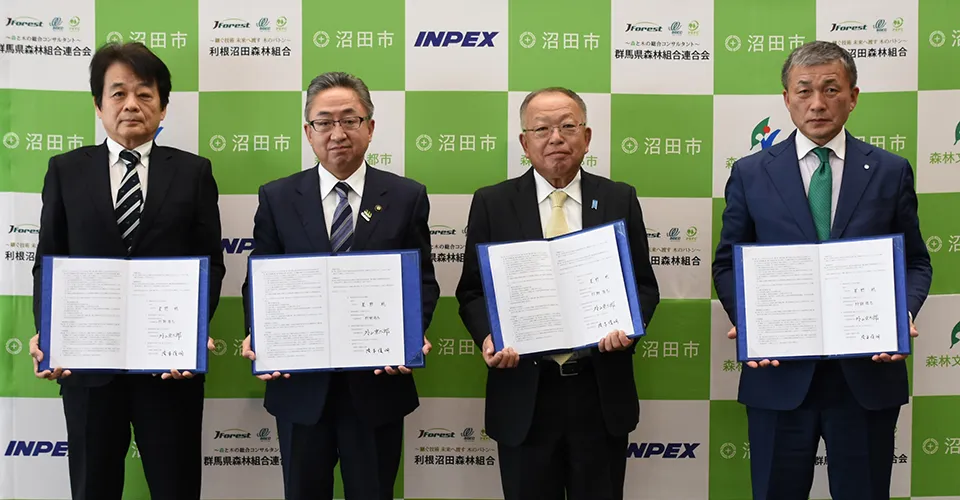
The Group is reducing GHG emissions through its businesses by providing CCS, hydrogen, ammonia, and other lower-carbon solutions. This is because we position credits that leverage CO2 absorption through forest conservation and afforestation as one of the means to complement our efforts to achieve net zero emissions through cleaner oil and gas businesses, a transition to natural gas, CCS, and renewable energy. Some examples of our efforts are the signing of a partnership agreement with Gunma Prefecture's Numata City and other parties such as forest associations to create J-Credits from forests owned by Numata City in FY2024. We also launched a project with the Gunma Prefecture Forest and Green Conservation General Incorporated Foundation and AERO TOYOTA CORPORATION to generate J-Credits derived from forests operated by the Foundation in FY2025. Through these efforts, as a responsible corporation, we seek to define new environmental and economic value of the forests and contribute to the sustainability of the forests and the local community. We will continue to promote efforts after taking into consideration the progress of our businesses, both in Japan and overseas, and the legal systems of each country, among other factors.
Related Page
-
Climate Change>Governance and Strategy
-
Climate Change>Risk Management
-
Climate Change>Metrics, Targets, and Results
-
Climate Change>Energy Transition