
Targets
Following our Corporate Position on Climate Change, the Group has set its own targets along two axes—decarbonization of its business and contribution to a lower-carbon society—to contribute to realizing a low-carbon society in support of the Paris Agreement. For the decarbonization of our business, we aim to achieve net zero in our emissions by FY2050, and as part of the process, reduce net carbon intensity by at least 60% versus the FY2019 level by FY2035. To achieve this target, in our 2025-2027 Mid-term Business Plan, we seek to achieve a net carbon intensity reduction of 35% versus the FY2019 level by FY2027 as a milestone. This target is reviewed every time we formulate our Medium-term Business Plan, and it has been revised upward following the early achievement of the previous target of 30% reduction versus the FY2019 level by FY2030 set in the previous Medium-term Business Plan. Next, as a contribution to a lower-carbon society, regarding the reduction of Scope 3 emissions, we will work together with all relevant stakeholders to address challenges across the value chain. At the same time, through providing CCS and other lower-carbon solutions and supplying clean power, we aim to generate 8.2 million tons of avoided emissions each year for society by FY2035. We will also continue to maintain methane emission intensity (methane emissions / natural gas production) at the current low level (approximately 0.1%) and aim to achieve zero routine flaring.
Targets for Addressing Climate Change
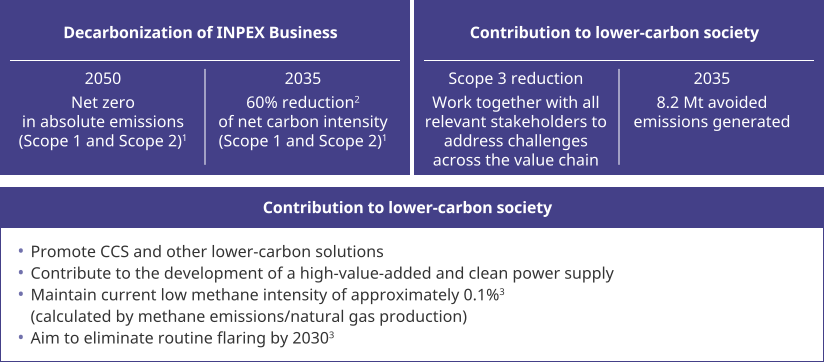
-
1On INPEX equity share basis
-
2In comparison with the FY2019 level. Note that the reduction ambition and targets reflect the current economic environment and reasonable expectations. These are premised on a business environment of consistent progress in decarbonization technology, economic rationality, and realization of policies in each country and region.
-
3In INPEX-operated projects
In addition to reducing our emissions, we also work on realizing a lower-carbon society. We set avoided emissions targets that contribute to realizing a lower-carbon society, and we will work toward them after strictly assessing the profitability of individual projects, taking into consideration the use of government support in each country.
Results
One of our targets for the decarbonization of our business relates to our net carbon intensity, which was 27 kg-CO2e/boe in FY2025, a decrease of 1 kg-CO2e/boe compared to the FY2024 level.
| Metrics | Targets (FY2035) |
Baseline (FY2019) |
FY2023 | FY2024 | FY2025 |
|---|---|---|---|---|---|
| Net carbon intensity4 | 60% reduction compared to FY2019 level5 (kg-CO2e/boe) |
41 | 28 | 28 | 27 |
| Methane emission intensity6 | Below 0.1% | N/A | 0.05 | 0.05 | 0.04 |
| Avoided emissions | 8.2 million tons | N/A | N/A | N/A | 1.11 |
Formula for Calculating Net Carbon Intensity

-
4Net carbon intensity including offset using equity share approach. It indicates the volume of GHG emitted per unit of consolidated production of oil and natural gas and generation of renewable energy (converted to calorific values) in Japan and overseas, and it applies to all seven types of GHGs. Net carbon intensity is calculated using the above formula.
-
5Reduction of 60% (in net carbon intensity) versus the FY2019 level by FY2035. As part of the process, reduction of 35% versus the FY2019 level by the end of the Medium-term Business Plan period (FY2025 to FY2027).
-
6Methane emission intensity using operational control approach. It indicates the volume of methane emitted in the production of natural gas in Japan and overseas. The target for methane emission intensity is a continuous effort with no target year set.
-
7Offsets include avoided emissions through renewable energy projects where the environmental value of said projects is considered to be attributable to us, and the offsets through carbon credits. The contributions from renewable energy are calculated based on the Guidelines for Measurement, Reporting and Verification of GHG Emission Reductions in JBIC GREEN Operation (J-MRV Guidelines).
Total Absolute GHG Emissions
GHG Emissions Results
| Types | Results (FY2025) | Standards Referenced |
|---|---|---|
| Scope 1 | 6,121 thousand tons-CO2e | GHG Protocol (2004) |
| Scope 2, location-based | 38 thousand tons-CO2e | GHG Protocol (2015) |
| Scope 2, market-based | 35 thousand tons-CO2e | GHG Protocol (2015) |
| Scope 3 Category 1 | 2,170 thousand tons-CO2e | GHG Protocol (2011) |
| Scope 3 Category 11 | 87,135 thousand tons-CO2e | GHG Protocol (2011) |
In calculating GHG emissions, the Group references the GHG Protocol. For Scope 1 and Scope 2, GHG emissions are calculated for the projects where the Group takes the role of operator, which is called the operational control approach.
For Scope 1 emissions, the amount of activity during the consolidated fiscal year is multiplied by the specific emission factors of national laws and regulations available at the end of the consolidated fiscal year. If specific emission factors cannot be obtained, the IPCC emission factors are used. The main sources of GHG emissions for Scope 1 emissions are CO2 produced in conjunction with subsurface fluids and fuel use at our facilities.
Under Scope 2 emissions, location-based emissions are calculated by multiplying the electricity consumption at each site during the consolidated fiscal year by the IEA emission factor for that country. Market-based emissions are calculated by multiplying the electricity consumption during the consolidated fiscal year by the emission factor for each electricity contract. If the emission factor for each electricity contract cannot be obtained, it is calculated based on the hierarchy of the GHG Protocol. The main cause of Scope 2 emissions is electricity use.
Considering the importance of Scope 3 emissions to the Group's business, we measure Category 1 (purchased goods and services) and Category 11 (use of sold products) emissions. Scope 3 Category 1 is the volume of contractor emissions and upstream emissions from the production of purchased goods, and is therefore information with a high degree of measurement uncertainty. Category 11 emissions are calculated by multiplying the Group's total sales volume of crude oil, natural gas, and LPG by IPCC emission factors under the assumption that all amounts of crude oil, natural gas, and LPG are combusted. Therefore, it is also information with a high degree of measurement uncertainty.
Collection, Analysis, and Reporting of GHG Emissions
We regularly collect, analyze, and report our GHG emissions in accordance with procedures based on host country systems and international guidelines, such as the GHG Protocol. We also obtain third-party assurance—using International Standard on Assurance Engagements (ISAE) 3410 as the verification standard—of our environmental data from SOCOTEC Certification Japan to ensure the reliability of our GHG emission reporting.
As part of efforts to reduce emissions in our upstream business in Japan, we participate in the Keidanren Carbon Neutrality Action Plan, which is a voluntary emission reduction initiative, through our membership in the Japan Energy Resources Development Association. In FY2021, we reexamined our targets for reducing emissions by FY2030. We are also a member of GX League and subject to the voluntary emission trading (GX-ETS Phase 1) that started in FY2023 in Japan. After carrying out calculations and monitoring according to the guidelines stipulated by the GX League's secretariat, since FY2024, we have been reporting our progress toward the voluntary targets of GX-ETS set based on the government's targets. From FY2026, we are carrying out appropriate measurement, monitoring, and reporting based on the revised Act on the Promoting Transition to the Decarbonized Growth Economic Structure.
Related Page
-
Climate Change>Governance and Strategy
-
Climate Change>Risk Management
-
Climate Change>Efforts to Reduce GHG Emissions
-
Climate Change>Energy Transition