
Our Policy
INPEX's Mission is to contribute to the creation of a brighter future for society through our efforts to develop, produce, and deliver energy in a sustainable way. Based on this Mission, to achieve sustainable growth and enhance our corporate value over the medium to long term, we fulfill our social responsibilities in cooperation with shareholders and other stakeholders. Furthermore, we continually strive to strengthen our corporate governance to ensure transparent, fair, and timely decision-making.
Please refer to the Corporate Governance section on our website for details on the Basic Policy on Corporate Governance and Corporate Governance Report.
Management Structure
To ensure efficient corporate management and highly effective supervision based on our Mission, we have adopted the structure of a company with Audit & Supervisory Board Members, whereby Audit & Supervisory Board Members audit the business execution of Directors, who are well-versed in their fields. In addition, to further increase the agility and efficiency of our management, we have introduced an Executive Officer System. This system strengthens our business execution structure to respond accurately and quickly to a rapidly changing management environment and business growth.
We have many opportunities to engage in important negotiations with governments and international energy companies. This requires Executive Directors and Executive Officers who possess knowledge, expertise, and international experience related to our business. They must also have in-depth knowledge of both the Company and their fields of expertise. Typically, Directors who were initially the Company's employees also serve as Executive Officers. This ensures the Board of Directors is well-versed in the current management and business environments, enabling them to make informed decisions regarding optimal business execution while maintaining effective management supervision functions. At the same time, at least one third of the Board consists of Independent Outside Directors. The measure aims to improve management transparency and strengthen the effective supervisory function of the Board. We leverage the objective perspectives of Independent Outside Directors, which may differ from those of Executive Directors. Given their independent standing, Independent Outside Directors are expected to provide advice based on their personal knowledge and experience. They oversee management and conflicts of interest transactions, and appropriately represent the views of stakeholders at Board of Directors meetings. Our Independent Outside Directors bring backgrounds in corporate management, academia, or specialized fields such as the resource and energy industry, finance, or legal affairs. They have been appointed based on their extensive experience and comprehensive insights.
We are making steady progress to increase the diversity of the Board in terms of gender and nationality. We have appointed a female Outside Director, a female Outside Audit & Supervisory Board Member, and a foreign national as a Director. Currently, two of the members of the Board, which includes Audit & Supervisory Board Members, are women, accounting for 13% of the total Board membership. We have also appointed two female Executive Officers through internal promotion, ensuring diversity in our management structure.
The Nomination and Compensation Advisory Committee deepens discussions on ensuring further diversity and the appropriate size and composition of the Board. The Committee then shares the content of these discussions with the Board. Diversity here includes gender, international experience and cultural background. In addition, the Company's target for the ratio of women on the Board of Directors is at least 30% by 2030.
Four of the five members of our Audit & Supervisory Board are Independent Outside Audit & Supervisory Board Members. The Board has been established pursuant to the Japanese law to strengthen the audit function, ensuring the independence of Audit & Supervisory Board Members and effectiveness of audits. Further efforts include assigning audit assistants to the Audit & Supervisory Board Members' Office—which assists Audit & Supervisory Board operations—and strengthening the Board's collaboration with the internal audit department (Audit Unit) and accounting auditor. Engagement partners of the accounting auditor are appropriately rotated into the role of accounting auditor in accordance with the Certified Public Accountants Act of Japan, with none of them involved in auditing duties for more than seven consecutive fiscal years. In addition, the lead engagement partner is not involved in auditing duties for more than five consecutive fiscal years.
We hold regular meetings for Outside Directors, Representative Directors, Audit & Supervisory Board Members, and the accounting auditor. These include meetings attended by Outside Directors, Audit & Supervisory Board Members, and Representative Directors; meetings attended by Outside Directors and Audit & Supervisory Board Members (which can include the accounting auditor); and meetings attended by Audit & Supervisory Board Members and Representative Directors. Meeting participants exchange opinions on a wide range of management-related material issues, the development and operation of internal control systems, and other corporate governance-related matters.
Corporate Governance Structure
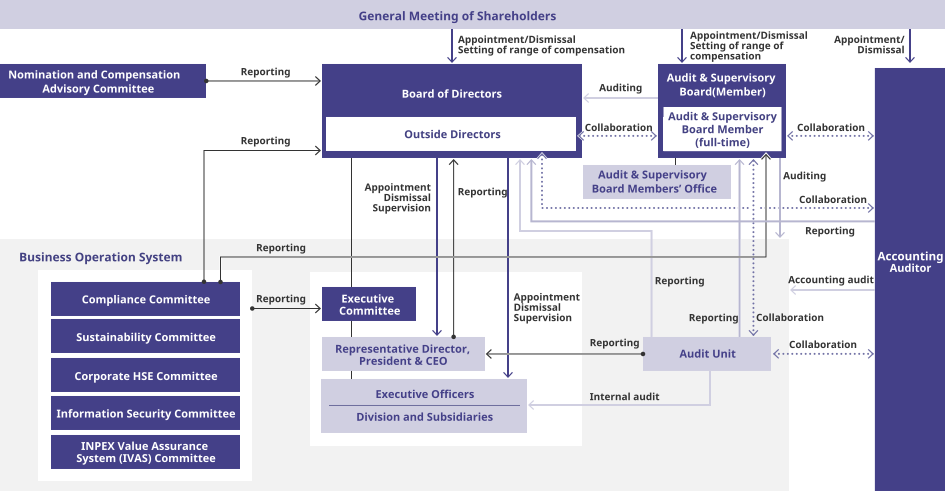
As of April 1, 2026
Directors and Board of Directors
The responsibilities of the Board of Directors include exercising its supervisory function to the full extent, ensuring fairness and transparency in management, fostering sustainable growth, and increasing corporate value over the medium to long term. This is achieved through effective corporate governance, acknowledging fiduciary responsibility to shareholders.
In addition to regular monthly meetings, the Board meets as needed to discuss and decide on matters concerning management strategy and material business operations. It also supervises the execution of duties by Directors.
The Articles of Incorporation state that the term of office of Directors shall be one year. This is to enhance their ability to promptly respond to changes in the global management environment and to further clarify management responsibilities.
Directors, Board of Directors Meeting Attendance, and Activities
The table below shows the composition of the Board of Directors as of April 1, 2026, and attendance at Board of Directors meetings in FY2025. Please refer to the Notice of the 20th Ordinary General Meeting of Shareholders (page 9) for details.
Attendance of All Directors at Board of Directors Meetings (FY2025)
| Position | Name | Responsibilities | Attendance at Board of Directors Meetings |
|---|---|---|---|
| Representative Director, President & CEO | Takayuki Ueda | - | 100% (15/15 times) |
| Representative Director, Senior Executive Vice President | Hitoshi Okawa | Senior Executive Vice President, General Administration and Oceania Projects, Head of Overseas Projects | 100% (15/15 times) |
| Director, Senior Executive Vice President | Toshiaki Takimoto | Senior Executive Vice President, Corporate Strategy & Planning, Legal Affairs, Compliance, Head of Low Carbon Solutions | 100% (15/15 times) |
| Director, Senior Managing Executive Officer | Daisuke Yamada | Executive Vice President, Finance & Accounting | 100% (15/15 times) |
| Director, Senior Managing Executive Officer | Hideki Kurimura | Executive Vice President, Technical Headquarters, HSE | -1 |
| Director (Outside) | Norinao Iio | Director (Outside) | 100% (15/15 times) |
| Director (Outside) | Hideka Morimoto | Director (Outside) | 100% (15/15 times) |
| Director (Outside) | Bruce Miller | Director (Outside) | 100% (12/12 times)2 |
| Director (Outside) | Naoko Saiki | Director (Outside) | -1 |
| Director (Outside) | Hidenori Takaoka | Director (Outside) | -1 |
-
*Representative Director Kenji Kawano and Director Tomoo Nishikawa resigned on March 28, 2025. They attended all three Board of Directors meetings held during their term of office.
-
**Outside Director Atsuko Nishimura resigned on February 28, 2026. She attended 14 out of 15 Board of Directors meetings held in FY2025.
-
***Director Hiroshi Fujii resigned on March 27, 2026. He attended all 15 Board of Directors meetings held in FY2025.
-
1Attendance in this fiscal year is not applicable because Director Hideki Kurimura, Outside Director Naoko Saiki, and Outside Director Hidenori Takaoka were appointed on March 27, 2026.
-
2Outside Director Bruce Miller was appointed on March 28, 2025.
Specific Content of Deliberations
| Specific Content of Deliberations | Number of Items Deliberated | ||
|---|---|---|---|
| Individual projects | Pillar for Growth 1 (Oil and gas business) |
Current status of overseas projects, the Ichthys Project, domestic projects, individual domestic and overseas projects, etc. | 24 |
| Pillar for Growth 2 and 3 (Other fields) |
Current status of low-carbon, renewable energy, and power-related businesses, individual domestic and overseas projects, etc. | 8 | |
| Strengthening of foundation | Human resource initiatives, nominations and compensation, corporate governance, internal control and internal audits, compliance, sustainability, legal affairs, materials and procurement, information and digital technologies, etc. | 65 | |
| Management strategy, business strategy, and cash allocation | Formulation of vision and Medium-term Business Plan, progress of Medium-term Business Plan, progress of management metrics, financial strategies and financing, investment allocation, shareholder returns policy, settlement of accounts and budget/results, production volumes and reserves, etc. | 24 | |
| HSE | Regular HSE reports, etc. | 12 | |
| Marketing | Marketing and trading of natural gas, LNG, and crude oil | 3 | |
| Total | 136 | ||
Audit & Supervisory Board
We have adopted an Audit & Supervisory Board Member system which comprises a five-member Board, including four Outside Audit & Supervisory Board Members. These four Outside Audit & Supervisory Board Members have abundant experience and knowledge of our business, finances, tax, international financing, management, and other fields, which they apply to their auditing duties. We have also established an Audit & Supervisory Board Members' Office, which is an organization independent from executive divisions that assists Audit & Supervisory Board Members in the execution of their duties. Several full-time employees with relevant knowledge and ability have been assigned to the Office. In principle, the Audit & Supervisory Board meets monthly on the same day as Board of Directors meetings, or as necessary. The Audit & Supervisory Board makes decisions on statutory matters including audit plans, and receives reports from the internal audit department and accounting auditor on the performance of their duties, requesting explanations when necessary. In addition, Audit & Supervisory Board Members share information on issues and other matters identified through audit activities and hold discussions on these as necessary.
In FY2025, a total of 18 Audit & Supervisory Board meetings were held and all Audit & Supervisory Board Members attended each of these meetings, as shown in the table below.
Audit & Supervisory Board Members
| Position | Name | Attendance at Audit & Supervisory Board Meetings in FY2025 |
|---|---|---|
| Full-time Audit & Supervisory Board Member | Akio Kawamura | 100% (18/18 times) |
| Full-time Audit & Supervisory Board Member (Outside) | Toshiya Tone | 100% (18/18 times) |
| Full-time Audit & Supervisory Board Member (Outside) | Kenichi Aso | 100% (18/18 times) |
| Audit & Supervisory Board Member (Outside) | Mitsuru Akiyoshi | 100% (18/18 times) |
| Audit & Supervisory Board Member (Outside) | Hiroko Kiba | 100% (18/18 times) |
Advisory Body
As an advisory body to the Board of Directors, we have established the Nomination and Compensation Advisory Committee, the Chair and a majority of members of which are Independent Outside Directors. The purpose is to strengthen the independence, objectivity, and accountability of the functions of the Board regarding the nomination and compensation of Directors and to contribute to the further enhancement of the corporate governance structure.
The table below shows the composition of the Nomination and Compensation Advisory Committee and attendance at its meetings in FY2025.
Nomination and Compensation Advisory Committee
| Name | Attendance | |
|---|---|---|
| Committee Chair | Jun Yanai (Independent Outside Director) | 100% (8/8 times) |
| Committee member | Norinao Iio (Independent Outside Director) | 100% (8/8 times) |
| Committee member | Atsuko Nishimura (Independent Outside Director) | 88% (7/8 times) |
| Committee member | Takayuki Ueda (Representative Director, President & CEO) | 100% (8/8 times) |
Key Deliberations
Nomination:
- Requirements for Directors (redefining of requirements)
- Director and Audit & Supervisory Board Member Skill Matrix
- Selection of candidates for Directors and Representative Directors
- Succession plan
- New Executive Officer structure for FY2026
Compensation:
- Review of the appropriateness of executive compensation levels (comparison with peer group)
- Company financial results, management metric results, and individual division results
- Performance-linked compensation (bonuses and stock-based compensation) KPI attainment forecasts and results
- Proposal of Director bonuses and stock-based compensation
Nomination and compensation:
- Annual deliberation schedule
- Review of key issues related to corporate governance (nomination and compensation matters)
Please refer to Internal Committees under Corporate Governance for details on other committees related to business execution.
Internal Control Related to Financial Reporting
Our Representative Director, President & CEO has responsibility for organizing and operating internal control related to financial reporting. Organization and operation of internal control related to financial reporting is conducted in accordance with the basic framework for internal control as indicated in "On the Setting of the Standards and Practice Standards for Management Assessment and Audit concerning Internal Control Over Financial Reporting (Council Opinions)" published by the Business Accounting Council. Results are reported to the Board of Directors and an internal control report is issued.
Evaluation Results of Effectiveness of Board of Directors in FY2025
With the aims of regularly verifying that the Board of Directors is functioning appropriately and identifying issues to resolve for continuing improvement, the Company undertakes an evaluation of the effectiveness of the Board of Directors each year, and discloses the summary of the evaluation results. Based on this policy, the 11th evaluation was conducted in FY2025. Please refer to the evaluation method and summary of the results for details.
Skill Matrix
The Board of Directors is composed of Directors and Audit & Supervisory Board Members who have diverse and abundant experience and insight for executing INPEX Vision 2035 - Realizing a Responsible Energy Transition aimed at realizing net zero emissions in 2050.
Director and Audit & Supervisory Board Member Skill Matrix
| Field | |||||||||||
|---|---|---|---|---|---|---|---|---|---|---|---|
| Position | Corporate Management / Business Administration | Global | Finance / Accounting | Legal / Risk Management | Sustainability | Technology / DX | Energy | Sales / Marketing | HR Development / Diversity | ||
| Director | Inside | Takayuki Ueda | ● | ● | ● | ● | ● | ||||
| Inside | Hitoshi Okawa | ● | ● | ● | ● | ● | ● | ||||
| Inside | Toshiaki Takimoto | ● | ● | ● | ● | ● | |||||
| Inside | Daisuke Yamada | ● | ● | ● | |||||||
| Inside | Hideki Kurimura | ● | ● | ● | ● | ● | |||||
| Outside | Norinao Iio | ● | ● | ● | ● | ||||||
| Outside | Hideka Morimoto | ● | ● | ● | ● | ||||||
| Outside | Bruce Miller | ● | ● | ● | ● | ||||||
| Outside | Naoko Saiki | ● | ● | ● | ● | ||||||
| Outside | Hidenori Takaoka | ● | ● | ● | ● | ● | |||||
| Audit & Supervisory Board Member | Inside | Akio Kawamura | ● | ● | ● | ||||||
| Outside | Toshiya Tone | ● | ● | ● | |||||||
| Outside | Kenichi Aso | ● | ● | ● | |||||||
| Outside | Mitsuru Akiyoshi | ● | ● | ● | ● | ● | |||||
| Outside | Hiroko Kiba | ● | ● | ● | |||||||
-
*The ⬤ symbol indicates fields in which the Company has particular expectations. The table does not represent the complete knowledge and experience of Directors and Audit & Supervisory Board Members.
Reasons for Selection of Items in Skill Matrix
| Skill Item | Reason for Selection |
|---|---|
| Corporate management / Business Administration | Under the complex management environment surrounding energy businesses, broad knowledge and experience of overall management and organizational operation are required to formulate and implement medium- to long-term management strategies and plans based on our Mission, and supervise effectiveness thereof. |
| Global | Knowledge and experience in the fields such as geopolitics and policies are required to effectively conduct global businesses we operate, and exercise appropriate supervision thereof. |
| Finance/accounting | Knowledge and experience in finance, accounting and tax affairs are required to plan and implement strategies for the achievement of targets, such as financial metrics and effectiveness metrics, called for in our Medium-term Business Plan, and exercise appropriate supervision thereof. |
| Legal/ risk management | Knowledge and experience in the fields such as legal affairs, compliance, corporate governance, and risk management are required to implement appropriate risk management and exercise supervision thereof. This includes compliance of domestic and overseas laws and regulations related to our management and businesses. |
| Sustainability | Knowledge and experience in health, safety, and environment (HSE) and sustainability management are required in the promotion of actions on various issues through our businesses and value chain, as well as the supervision of progress of these actions, in accordance with the Sustainability Principles and HSE Policy. |
| Technology/DX | Technical insight on the overall exploration and production (E&P) business as well as broad knowledge and experience in development, innovation, and progress of diverse energies and decarbonization solutions utilizing digital and specialized technologies are required to plan and implement strategies for technologies and DX that help the realization of a stable energy supply and a low-carbon business footprint, and exercise appropriate supervision thereof. |
| Energy | Broad knowledge and experience are required in not only our core businesses but also commercialization, development, production, and operation of diverse energies, including renewable energy, carbon capture and storage (CCS), hydrogen, and ammonia, to plan and implement our energy business strategies for the realization of a responsible energy transition, and exercise appropriate supervision thereof. |
| Sales/marketing | Knowledge and experience in sales and marketing of diverse energies are required to provide optimal products/services and added value to all customers in Japan and overseas, plan and implement marketing strategies for new customers to expand customer base, and exercise appropriate supervision thereof. |
| HR development / diversity | As a global corporation, we recognize the significance of diversifying our human resources (workforce) and cultivating human resources (individuals) who resonate with our values to foster responsible management in a sustainable manner. Diverse knowledge and experience in the fields such as human resources, education, and women's empowerment are required to plan and implement strategies related to human resource development and diversity, and exercise appropriate supervision thereof. |
Compensation for Directors
Basic Policy for Compensation
Our basic policy on compensation for Directors is as follows. The compensation shall:
- be attractive to recruit and retain qualified management human resources to realize our Mission,
- raise awareness of the need to contribute to the sustainable growth and medium- to long-term enhancement of our corporate value, and
- be highly transparent and objective to ensure accountability to shareholders and other stakeholders.
Based on the basic policy, we have passed a resolution at a Board of Directors' meeting as detailed below, on matters such as the policy for determining the details of compensation for individual Directors. Regarding the details of compensation and such for each individual Director, as an advisory body to the Board, the Nomination and Compensation Advisory Committee, the Chair and a majority of members of which are Independent Outside Directors, conducts a multifaceted review including consistency between the draft and the decision policy. The Board determines the details of compensation and such for each individual Director while respecting the Committee's report. As such, the Board confirms that the details of compensation and such for individual Directors aligns with the relevant policy.
Compensation Levels
The levels of compensation for our Directors shall be set by a resolution of the Board of Directors once the Nomination and Compensation Advisory Committee reviews the appropriateness of the levels after conducting surveys and analysis of the levels for each position among peer groups in companies of similar sizes and industries by using data from external research organizations. The compensation shall be reviewed as necessary based on factors such as changes in the external environment.
Compensation Composition
The compensation composition of our Directors (excluding Outside Directors) consists of basic compensation in accordance with the duties and other aspects of each position, bonuses as short-term incentive compensation, and stock-based compensation as medium- to long-term incentive, as shown in the table below. Compensation for Outside Directors consists only of basic compensation from the perspective of the independence of their duties. The compensation for Directors, which includes basic compensation and bonuses, is paid from the total amount approved at the General Meeting of Shareholders.
Compensation Composition
| Details | Levels, KPIs, Etc. | |||
|---|---|---|---|---|
| Basic compensation |
|
The Nomination and Compensation Advisory Committee reviews the appropriateness of compensation levels after conducting surveys and analysis on the levels for each position among peer groups in companies of similar sizes and industries using data from an external research organization. | ||
| Bonuses (Not applicable to Outside Directors) |
|
Bonus KPIs | Evaluation Weight | |
| Financial metrics | Net income | 45% | ||
| Cash flows from operating activities before exploration | 45% | |||
| Non-financial metrics | Safety metrics (zero major incidents) | 10% | ||
| Stock-based compensation for Directors and Executive Officers (Not applicable to Outside Directors)1 |
|
Stock-based Compensation KPIs | Evaluation Weight | |
| Financial metrics | Net income | 30% | ||
| Cash flows from operating activities before exploration | 30% | |||
| ROE | 10% | |||
| ROIC | 10% | |||
| Total return ratio | 10% | |||
| Non-financial metric | Net carbon intensity | 10% | ||
-
1The stock-based compensation system for Directors and Executive Officers does not apply to those who do not reside in Japan.
The ratio of the President's basic compensation, bonuses, and stock-based compensation when the target achievement level for each metric is 100% is set generally at 50%:30%:20%, respectively.
Malus and Clawback
In the event that serious misconduct or violations occur involving Directors, the Company may cancel or forfeit (malus) their basic compensation, bonuses, and stock-based compensation (including rights to receive the Company's shares), and may require the return (clawback) of such compensation.
Process for Determining Compensation for Directors
As an advisory body to the Board of Directors, we have established the Nomination and Compensation Advisory Committee, the Chair and a majority of members of which are Independent Outside Directors. The purpose is to strengthen the independence, objectivity, and accountability of the Board's function in determining Directors' compensation. Based on the report of the Committee, the Board establishes a policy for determining the amount of compensation for Directors and the method of calculating such amount.
The Committee shall, in principle, meet at least four times a year to deliberate major matters concerning the policy for determining the amount and calculation method of compensation and such for Directors and the details of compensation and such for each Director, and to provide advice and proposals to the Board. The Board makes decisions with the utmost respect for the content of such advice and proposals. The amount of compensation to be paid to each Director (including the final amount of bonuses based on the evaluation of the performance of the division in charge) shall be decided by the Representative Director, President & CEO, who is most familiar with our management situation, based on the content of the advice and proposals of the Committee.
Considering the external environment, social and economic trends, and other situations surrounding the Company, the Committee shall carefully deliberate on the appropriateness of the target value and calculation method for performance-based compensation and may make adjustments to the calculation of the amount of compensation for each Director by resolution of the Board.
We do not disclose the total amount of consolidated compensation and such paid to each Director or Audit & Supervisory Board Member. This is because there is no one Director or Audit & Supervisory Board Member whose consolidated compensation is 100 million yen or more, which is the disclosure standard stipulated in the Cabinet Office Ordinance on Disclosure of Corporate Affairs issued by the Financial Services Agency of Japan.
Training for Directors and Audit & Supervisory Board Members
To ensure that Directors and Audit & Supervisory Board Members can effectively fulfill their roles and responsibilities, we provide comprehensive explanations on material matters such as our business and management strategies, along with business risks, to newly appointed members. We also provide each Director and Audit & Supervisory Board Member with the necessary training opportunities (training by experts, site visits, etc.). In FY2025, we provided training sessions for Executive Directors (3 sessions) and Outside Directors (9 sessions). These include 4 sessions on business risks.
In addition, we strive to enhance collaboration and business knowledge among the Board of Directors by arranging regular lectures and opinion exchange meetings with external experts on topics such as the energy situation.
Regulations on Disciplinary Action Against Officers, Etc.
The INPEX Group has established the Regulations on Disciplinary Action against Officers, Etc., which apply to Directors, including Outside Directors, Executive Officers, and others. These Regulations define acts such as violations of laws, regulations, and internal rules as grounds for disciplinary action, and provide for disciplinary measures including reduction, return, forfeiture, and dismissal in relation to compensation (basic compensation, bonuses, and stock-based compensation). In determining disciplinary measures, the Group has established procedures to ensure fairness and effectiveness, including having the compliance department investigate the facts, providing the officers and others subject to disciplinary action with an opportunity to present an explanation at a Board of Directors meeting, and having the Board of Directors pass a resolution on the disciplinary measures.
Related Page
-
Sustainability Structure
-
Progress of Action Plans for each Materiality
-
Risk Management
-
ESG data>Governance