
Efforts to Reduce Incidents
As part of our efforts toward incident prevention, we continue to share learning from incidents, and analyze and share trends in major incidents and other incidents resulting in injury.
We also monitor two leading safety KPIs related to incident management—implementation of incident investigations and implementation of high-priority corrective actions—to strengthen our ability to conduct prompt investigations and take remedial actions.
Incident investigations are conducted promptly and the results are required to be submitted within 7 to 40 days of the incident, depending on the severity. Bulletins and lessons drawn from incidents are shared with all employees through the HSE Portal and other methods. All incidents reported during FY2025 were investigated and corrective actions were taken.
Further activities to prevent major incidents include firmly embedding Lifesaving Rules into our business to ensure the safe performance of tasks that carry a significant risk of fatality. We strive to ensure awareness of the Lifesaving Rules among our contractors as they represent over 80% of the incidents resulting in injury. At the Ichthys LNG Project, we also conduct a coaching program and hold HSE forums with our employees and contractors to promote greater awareness of HSE.
Please refer to Initiatives for Emergency Response and BCP for details on emergency responses and BCP.
Process Safety Management
Process safety management is the framework for managing the integrity of operating systems and processes according to appropriate design concepts, engineering, as well as operating, maintenance, and inspection methods. The aim is to prevent or mitigate the impact of the leakage of flammable liquids or other hazardous materials or the occurrence of MAEs, such as fires and explosions.
By ensuring process safety management, we endeavor to prevent leakage in the operation of our facilities.
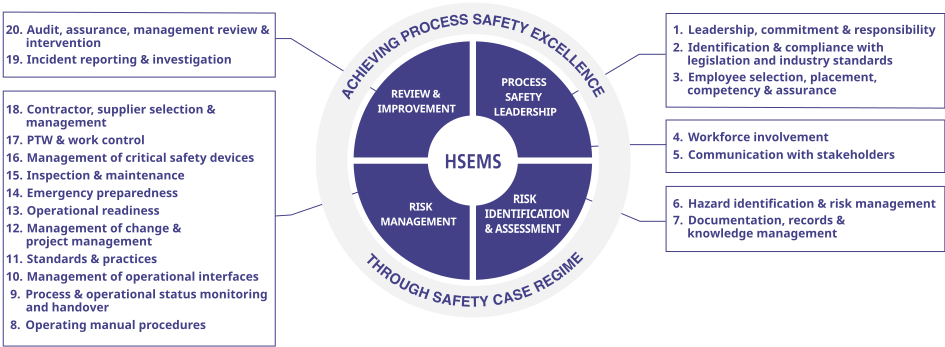
Our process safety management framework consists of four focus areas and 20 elements. Each element has a detailed set of expectations to which operator projects must adhere. Within the process safety management framework, we prevent process leakage-related major accident events (MAEs) at facilities through systematic identification and assessment of risks. We have also voluntarily adopted a Safety Case document regime at our operational facilities. This demonstrates sufficient implementation of measures to reduce the impact of MAEs, and ensures risks are controlled to as low as reasonably practicable (ALARP).
In FY2022, we created the 2023-2027 Roadmap for Ongoing Improvements to Process Safety Management. With the aim of systematic implementation of ongoing improvements, this roadmap outlines the process involved in bringing all organizations in the INPEX Group to the same level of maturity in five priority areas by FY2027. This roadmap is being applied from FY2023 onward to strengthen our process safety management. In FY2025, toward operation of mechanisms for ensuring Group-wide process safety management competency, we conducted awareness-raising activities for the persons in charge of operational organizations to recognize the importance of demonstrating leadership. At the same time, we promoted preparations toward trial implementation of these mechanisms at each organization. Furthermore, we also worked on improving the processes for managing and reporting Group-wide HSE risks, including process safety incidents, as well as the analysis and such of industry incident cases. Continuing from FY2024, we also applied our process safety knowledge to the fields of hydrogen, ammonia, and CCUS.
Process Safety Management Framework
Fostering of HSE Culture
We conduct activities to foster HSE culture to establish a mindset that prioritizes HSE within our organizations. This includes developing our HSEMS, providing HSE education and training, and sharing learning from incidents (LFI)*1 with all employees.
As part of our efforts to foster HSE culture, we conduct an annual Corporate HSE Awards program. The awards aim to motivate our workers and raise HSE awareness among our organization, and improve our Group-wide HSE performance. In FY2025, we presented eight awards: a HSE Excellence Award to one group, HSE Activity Awards to five groups and one individual, and one partner company.
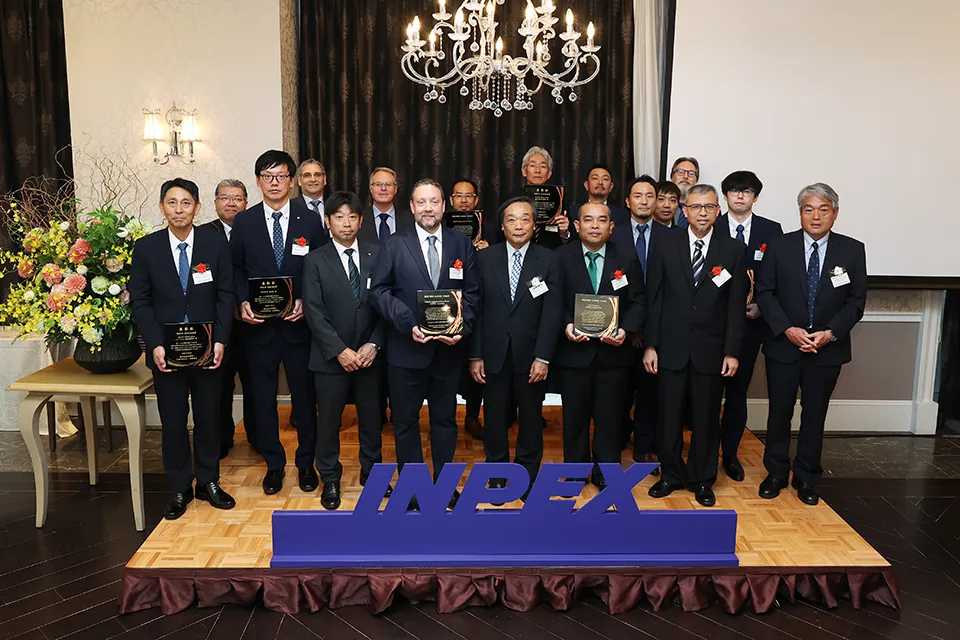
To facilitate a top-down approach to raising awareness of HSE among our employees, we engage our senior management to proactively carry out HSE activities.
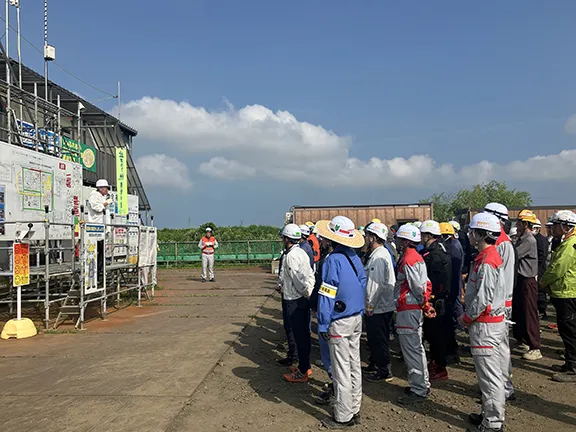
Site visits by senior management are valuable opportunities for them to demonstrate HSE management leadership and communicate directly with site workers through talking about HSE initiatives and challenges. Our senior management delivers a unified safety message to each site with the aim of increasing our Group-wide HSE awareness. In FY2025, our Executive Officers made five site visits in Japan, including four by the Senior Executive Vice President and one by the Executive Officer in charge of HSE.
-
Dialogue with contractors at the construction site of Kashiwazaki Hydrogen Park
-
Plant visit at Kashiwazaki Hydrogen Park
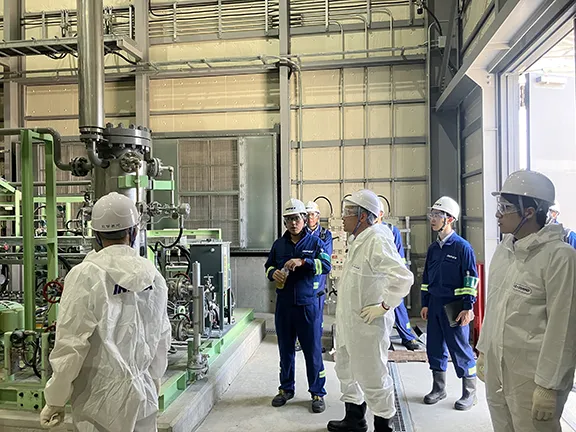
In July, the Executive Officer in charge of HSE visited the construction site of Kashiwazaki Hydrogen Park, during which he conveyed INPEX's emphasis on being thorough in Lifesaving Rules and the message of safety first—not hesitating to stop work when danger is felt. The plant's process equipment and safety facilities were also checked, and discussions were conducted regarding the HSE risks, emergency responses, and other topics in the handling of flammable liquids such as hydrogen and ammonia.
-
*1Lessons from incidents obtained through incident investigations
Education and Training for Enhanced HSE Competency
In FY2025, a cumulative total of 585 employees attended internal workshops and training sessions, through which we conducted 775 hours of HSE education and training. In addition, we are providing ongoing hands-on training opportunities both in Japan and overseas for junior technical employees, so they can acquire practical skills in occupational safety management and process safety engineering.
We also develop training targets according to field for employees in charge of HSE and enable them to further develop their HSE competency through on-the-job training (OJT) and training programs from external providers specializing in HSE. We will continue to provide opportunities for education and training to employees in FY2025 as we endeavor to raise the level of HSE competency.
Further, all contractors are provided with inductions when attending any of our sites.
Related Page
-
Safety>Governance and Strategy
-
Safety>Risk Management
-
Safety>Metrics, Targets, and Results
-
ESG data>Social