
Please refer to Governance > Risk Management for details on overall sustainability risk management.
Regarding HSE risks, we apply risk management based on our HSEMS. We adopted our HSEMS to ensure implementation of the HSE Policy in our business activities. Our HSEMS is based on the International Association of Oil & Gas Producers (IOGP) OMS510*1 report and references the international standards ISO 9001, ISO 14001, and ISO 45001. Based on the principles of leadership, risk management, and continuous improvement, OMS510 is the foundation for improving the performance and effectiveness of our HSEMS. With the HSEMS of OMS510 as the base, the HSEMS Standard sets forth essential structural requirements for implementing the HSEMS, including the preparation and revision of key HSE documents (rules, standards, guidelines, etc.), the development of HSE organizations, as well as HSE-related technical support for each division, education and training, communication activities, and periodic audits and reviews. With these elements incorporated in the management system, we carry out comprehensive HSE risk management.
HSEMS Structural Diagram
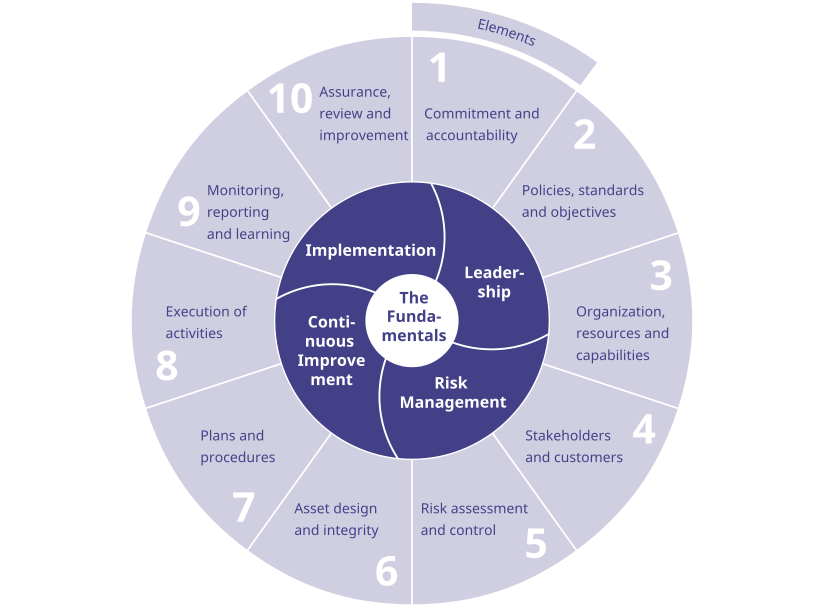
In addition, the following periodic reports are made as a mechanism to reflect key HSE risks in corporate strategies and decision-making.
- Executive Committee (monthly): The Director, Executive Vice President in charge of HSE and the HSE Unit report to the Executive Committee on the status of the INPEX Group's HSE metrics, incidents, etc.
- Executive Committee (quarterly): The Director, Executive Vice President in charge of HSE and the HSE Unit report to the Executive Committee after receiving reports on major HSE risks from all operator projects.
-
*1IOGP Report No. 510 "Operating Management System Framework for controlling risk and delivering high performance in the oil and gas industry"
HSE Objectives and Programs
Our corporate HSE Unit sets HSE objectives to ensure the continuous improvement of our HSEMS and achieve Group-wide HSE management. It also develops and implements an annual HSE program that outlines activities to achieve the key HSE objectives at each site as well as at the corporate level, and manages progress toward achieving the objectives.
Our ultimate goal is to ensure that all workers at workssites can return home each day free from injury. The safety of the employees and contractors involved in our projects is our top priority, so we manage safety risks through our HSEMS.
The main outcome from our corporate HSE activities in FY2025 was the improved communication between senior management and site workers which was achieved through site visits by senior management and the special awareness month campaign. In addition, we take the fatality that occurred at a construction site in Japan seriously. We went beyond incident investigation at the site level to conduct it at the corporate level, thoroughly investigating the factors behind the incident. Based on the investigation results, we formulated safety measures for domestic sites and are working Group-wide to prevent recurrence of incidents. Please refer to Metrics, Targets, and Results for details on the status of our HSE objective achievement in FY2025.
HSE objectives incorporating key safety measures for FY2025 are detailed below.
- Initiatives for Group-wide incident reduction to achieve zero major incidents
- Ensure compliance with Life-Saving Rules and implement safety measures at each site
- Analyze incident trends and enhance measures for specific risks
- Manage health, including mental health, at each site and maintain healthy and safe workplace environments
- Enhancement of Group-wide process safety management
- Build mechanisms for improving process safety management competency and prepare for Group-wide implementation
- Enhance process safety management by reviewing process safety management requirements and adopting them into the net zero businesses, etc.
- Establishment and implementation of HSE management in all business areas
- Develop a roadmap for reorganizing HSEMS documents in response to business diversification, plan assurance activities, and confirm the effectiveness of the HSEMS
- Enhancement of HSE communication by senior management
- Facilitate regular HSE communication by senior management and leaders at our worksites
HSE Audits
To assess whether the HSEMS is being utilized consistently, in addition to regular audits conducted by the Audit Unit, the HSE Unit also develops an annual HSE audit program for operational organizations and conducts HSE audits based on the program.
HSE audits consist of two levels: corporate HSE audits conducted by the corporate HSE Unit on operational organizations, and operational HSE audits conducted by operational organizations on gas fields and other sites under their management. As a result, our structure ensures HSEMS internal audits are planned and conducted annually on all sites.
In addition, the Nagaoka Field Office, our largest field office in Japan, obtained the ISO 14001 international certification for environmental management systems in FY2003 and has since maintained it in conjunction with our HSEMS. The Nagaoka Field Office conducts internal and external audits as required by ISO 14001.
Related Page
-
Safety>Governance and Strategy
-
Safety>Metrics, Targets, and Results
-
Safety>Other Initiatives
-
ESG data>Social