
In recent years, the global shift toward a nature-positive future that halts and reverses biodiversity loss has become a major focus. One example is the adoption of the Kunming-Montreal Global Biodiversity Framework at the 15th meeting of the Conference of the Parties to the Convention on Biological Diversity (COP15) in 2022. To contribute to realizing a nature-positive future, the INPEX Group is advancing a net positive approach.
Because our businesses can have significant impacts on society and the environment, we have identified biodiversity as a material issue. We are also identifying dependencies and impacts, as well as risks and opportunities, in line with the TNFD recommendations. Please refer to our TNFD-related Initiatives for details.
In our operational projects in Japan and overseas, we assess the risks and impacts our businesses have on biodiversity and work to conserve biodiversity through avoidance, mitigation, and compensation based on the mitigation hierarchy. In addition to reducing negative impacts, we also engage in activities that create positive impacts on biodiversity, such as forest conservation. For example, in Australia, in collaboration with the Northern Territory authorities and INPEX Australia, rangers including the Larrakia people lead and carry out a conservation management program. This program aims to conserve and manage dugongs, cetaceans, and other threatened marine Matters of National Environmental Significance*1, while also maintaining the management capabilities of Indigenous ranger groups.
This feature highlights selected biodiversity conservation initiatives in Japan.
-
*1Matters of environmental importance and values designated as nationally significant under Australian federal law and related regulations. These include, for example, threatened species and ecological communities, World Heritage areas, National Heritage places, wetlands, and certain water resources.
Kitsunedaira Donguri-no-Mori
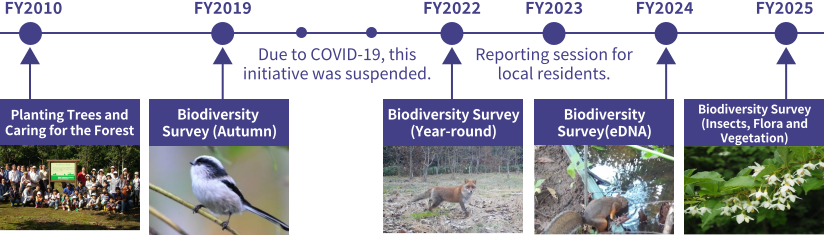
Since FY2010, in the Fudosawa area of Nagaoka City, Niigata Prefecture, adjacent to the Nagaoka Field Office, we have carried out the Kitsunedaira Donguri-no-Mori forest conservation activities together with local residents as part of Niigata Prefecture's Forest Management Support Program. In addition to the forest conservation activities, since FY2019, we have been conducting biodiversity surveys in Kitsunedaira Donguri-no-Mori to investigate the species that use and inhabit the forest. In FY2025, we conducted surveys of insects and plants.
Planting Trees and Caring for the Forest
- As part of Niigata Prefecture's "Forest Management Support Program" launched in FY2010, we have been conducting the Kitsunedaira Donguri-no-Mori (Acorn Forest) Project.
- In addition to ongoing conventional forest conservation activities, a biodiversity pilot survey was conducted in autumn of FY2019.
- Based on the results of the autumn FY2019 survey, a year-round survey was conducted in FY2022.
- The results of the survey were shared with participants in forest conservation activities in FY2023.
- In addition to ongoing conventional forest conservation activities, environmental DNA analysis was conducted in FY2024.
- In FY2025, biodiversity surveys of terrestrial insects and plants were conducted.
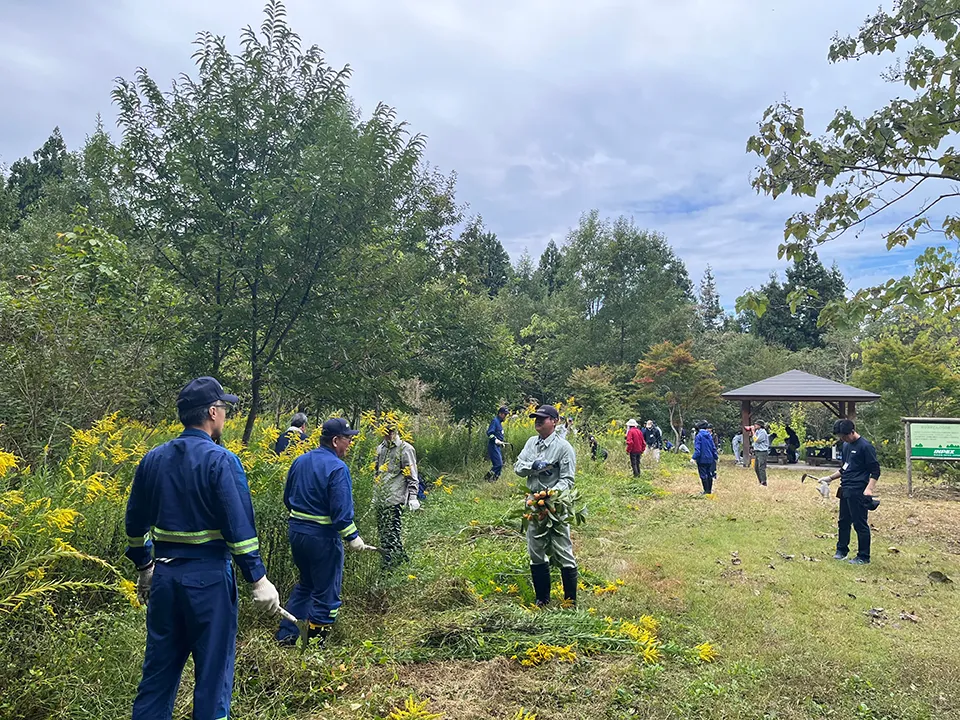
Twice a year, in spring and autumn, we work with local community members on forest maintenance, tree planting activities, and nature observation sessions for children. (This initiative was suspended in FY 2020 due to COVID-19 and recommenced in FY 2024.)
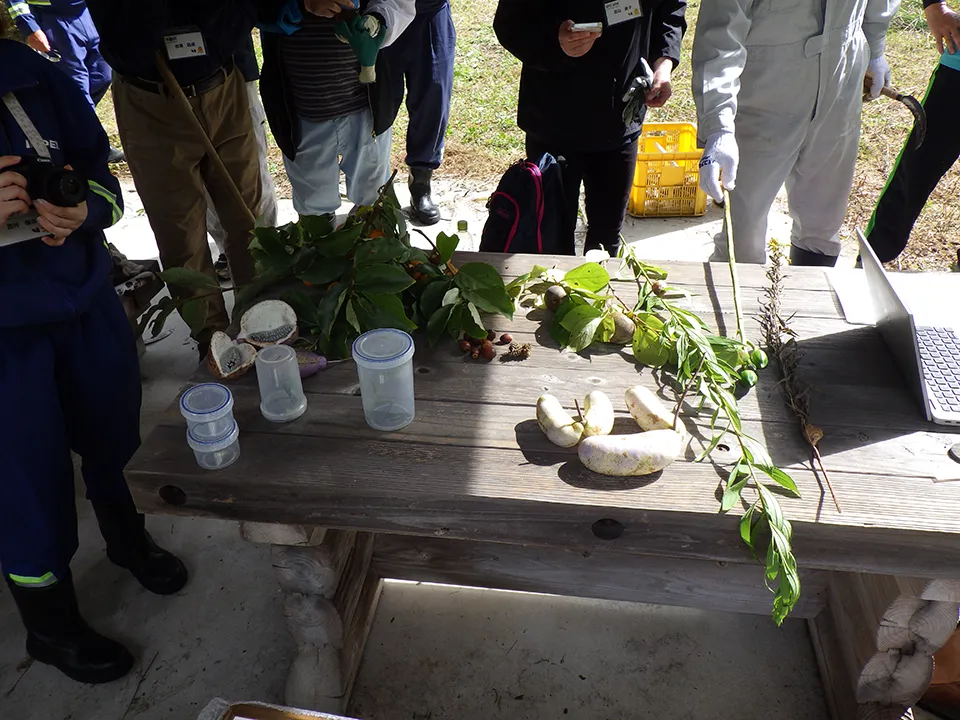
In FY 2025, in addition to our regular forest conservation activities, we held insect-collecting and plant-observation events at Kitsunedaira Dongurfi-no-Mori as part of environmental education for children.
-
Planting trees and caring for the forest
-
Environmental education
FY2025 Biodiversity Survey
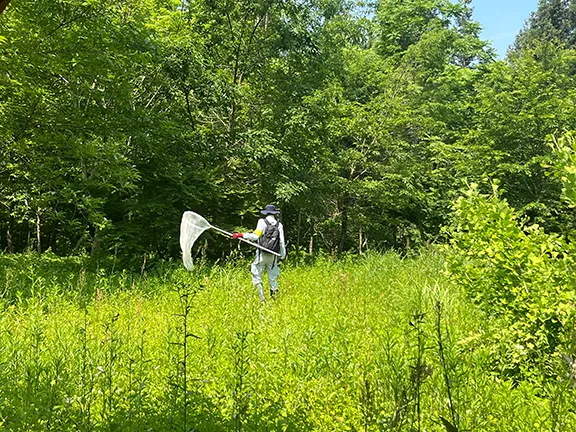
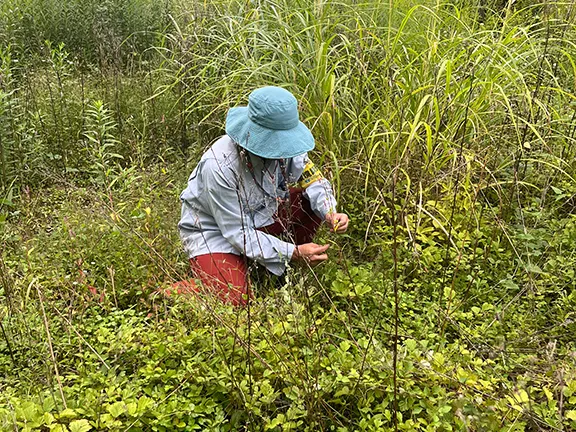
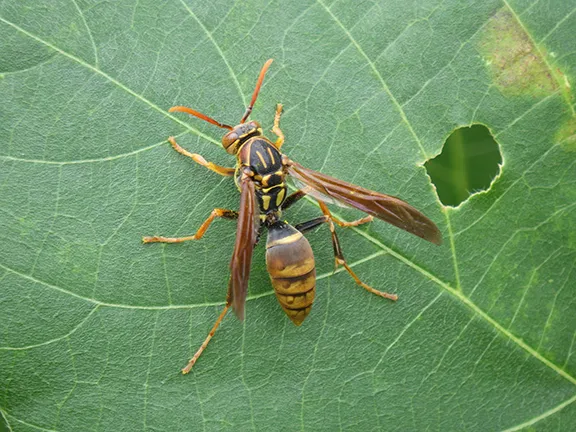
Until now, our surveys had focused mainly on mammals and birds. In FY2025, however, we carried out a biodiversity survey focused on terrestrial insects and plants. In addition to a literature review, the insect survey included opportunistic net sampling and visual observation. The plant survey recorded plant species through visual observation and examined vegetation and flora.
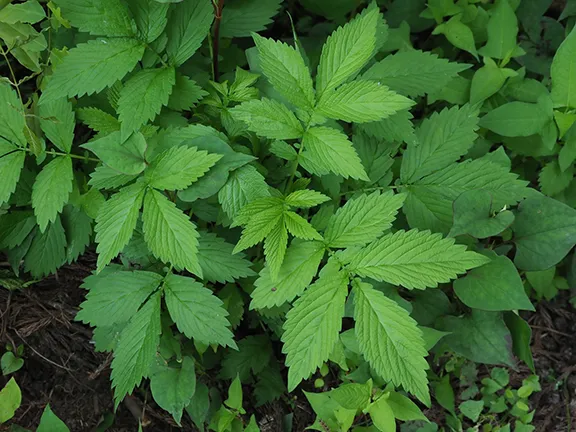
The survey results showed that Kitsunedaira Donguri-no-Mori provides a favorable habitat for tree-dwelling insects. They also suggest that the ongoing forest conservation activities have maintained grassland areas and helped create a habitat base for insects that prefer open grassland environments. The plant survey confirmed a diverse tree environment. At the same time, it found several non-native species in the grassland environment, and the vegetation structure was dominated by single species such as tall goldenrod and kudzu. These findings indicate that if these species continue to spread, the understory vegetation could become more uniform and affect the ecosystem.
Based on these survey results, we will update our forest conservation and weeding activities from next year onward. This will include actively removing the non-native species identified in the survey and carrying out weeding to prevent vegetation from becoming more uniform.
-
Insect survey
-
Vegetation survey
-
Japanese paper wasp
-
Yellow avens
Biodiversity Preservation Site
Since FY2023, the Ministry of the Environment has operated a system that certifies areas where biodiversity is conserved through private sector initiatives and other efforts as Biodiversity Preservation Sites. In FY2025, this system was enforced in law under the Act on Promoting Activities to Enhance Regional Biodiversity. In addition, the 30by30 Alliance, a voluntary alliance of companies, local governments, and organizations, was launched to help achieve the 30by30 target of conserving 30% of the Earth's land and sea areas by 2030.
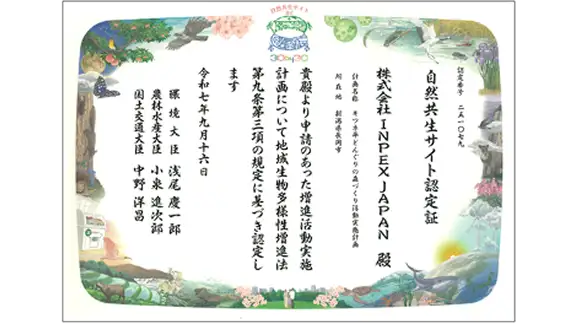
Under these frameworks, the Kitsunedaira Donguri-no-Mori forest conservation activities were certified in September 2025 under the Act on Promoting Activities to Enhance Regional Biodiversity in recognition of their role in maintaining and conserving the site's rich biodiversity. The area where the certified activities are carried out was also registered as a Biodiversity Preservation Site. Accordingly, INPEX CORPORATION and INPEX JAPAN, LTD. joined the 30by30 Alliance.
-
Certification of the Biodiversity Preservation Site
-
Biodiversity Preservation Site logo

Measuring the Impact of Forest Conservation Activities on Biodiversity
In this initiative, we analyzed and evaluated how much the forest conservation activities contribute to biodiversity conservation in Kitsunedaira Donguri-no-Mori. This site is a rare satoyama environment in Niigata Prefecture and is located in an ecotone where mountains, wetlands, plains, and rivers meet. That makes it an important area for biodiversity conservation. A scenario analysis compared how different forest management policies affect biodiversity, including the average number of species per mesh. The results showed that continued and strengthened appropriate management is likely to maintain and increase the number of species over the long term, while abandoned or insufficient management could reduce the number of species. These results confirmed that the forest conservation activities that have continued since FY2010 have had a certain positive effect on biodiversity conservation in the area. Please refer to Measurement of Impacts on Biodiversity from Forest Management Activities for details.
Based on these results, we will continue our current management while also considering and implementing forest conservation activities that create more diverse habitats and generate positive impacts for a wider range of organisms.
INPEX JAPAN Forest
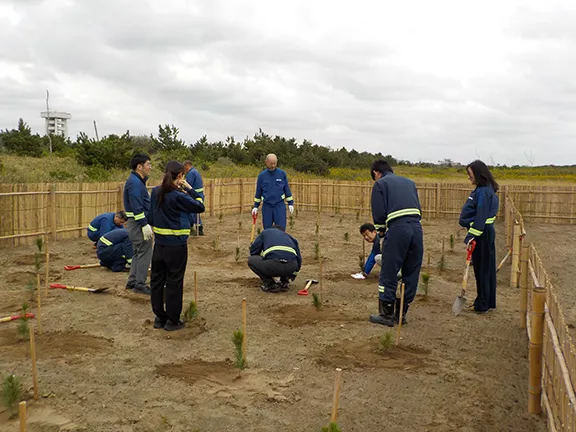
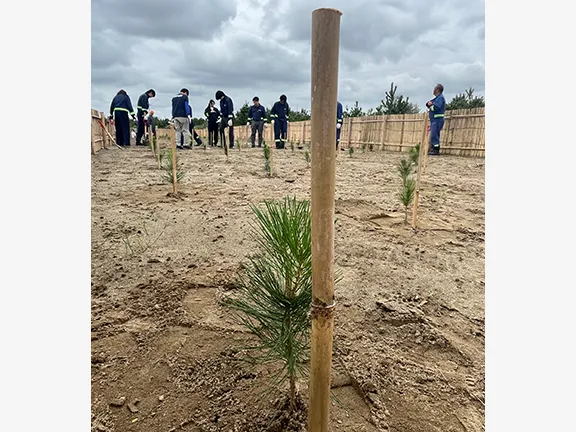
INPEX JAPAN joined Chiba Prefecture's Corporate Forest Project in FY2025 at Hasunuma Beach in Sanmu City, Chiba Prefecture. Under this project, companies and organizations carry out forest maintenance in prefectural forests. At Hasunuma Beach, many Japanese black pines have been planted and managed as a coastal forest to help reduce local hazards such as strong winds and tsunamis. At the same time, many trees have been damaged by salt and pests.
In the fall of 2025, as the first activity under this project, 12 of our employees planted Japanese black pine seedlings. Going forward, we will continue tree planting and weeding activities to help maintain and enhance the related ecosystem services.
-
Tree-planting activity
-
Japanese black pine
Message from Director Morimoto

Because resource development inevitably involves altering nature, we need to place special emphasis on biodiversity conservation. At INPEX, we have identified biodiversity conservation as a material issue and are committed to advancing a net positive approach to help realize a nature-positive future.
To put this into practice, we have set quantitative targets and are implementing rigorous biodiversity assessments across all operational projects. We are also steadily implementing biodiversity conservation activities, including project measures based on the mitigation hierarchy.
We are already expanding the scope of these activities, mainly in the areas where we operate in Japan and overseas. For example, in Australia, where environmental regulations are strict, INPEX has gone beyond regulatory compliance and worked proactively with the Larrakia people on biodiversity conservation. In Japan, we are also taking steps such as identifying species through environmental DNA. I highly value the breadth of these efforts.
In Japan, biodiversity is deteriorating across wide areas due to population decline and depopulation, and biodiversity conservation and regional revitalization cannot be separated. Against this backdrop, I hope INPEX, which operates businesses in areas such as Niigata and Chiba and covers a broad area with its 1,500-kilometer pipeline network, will build a rich and compelling narrative that connects conservation activities with regional revitalization under its goal of pursuing a net positive approach.
From a sustainability standpoint, it is also important to encourage broader employee participation in conservation activities and establish this as a company-wide theme. I hope INPEX will strengthen such efforts.
Related Page
-
Feature 1:Power in Diversity: A Dialogue - Director and Employees
-
Biodiversity Conservation and Environmental Pollution Measures>TNFD-related Initiatives
-
Biodiversity Conservation and Environmental Pollution Measures>Biodiversity Conservation
-
Editorial Policy