
INPEX is enhancing its biodiversity and nature-related initiatives in line with global trends.
Since participating in the TNFD Forum in FY2022, and have started gathering information related to the Taskforce on Nature-related Financial Disclosures (TNFD) framework*1 and conducting internal assessment on a trial basis.
With the final recommendations of the TNFD published in September 2023, there is increasing global interest in the organization's nature-related measures and disclosure requirements. The TNFD disclosure recommendations include required assessment and actions factoring in nature-related materiality, regional characteristics of businesses, and value chains. While considering the best way to meet these disclosure requirements, we will undertake ongoing assessment, improvement, and disclosures. This includes identifying the required data and developing assessment processes.
-
*1The TNFD framework was developed by the TNFD to assess nature-related risks and opportunities, and to disclose that information. The LEAP approach is a process proposed in the framework for systematically assessing nature-related risks and opportunities. The LEAP approach involves four phases: (1) Locate the interfaces with nature; (2) Evaluate dependencies and impacts on nature; (3) Assess nature-related risks and opportunities; and (4) Prepare to respond to nature-related risks and opportunities, including reporting on material nature-related issues to the primary users of financial reports and other stakeholders.
Nature-related Governance
Governance Structure
INPEX's governance structure for environmental management, including biodiversity conservation, is detailed in Sustainability Structure under the heading of Governance.
Stakeholder Engagement
To properly manage our business activities' impacts and dependencies on the natural environment and biodiversity, we strive to build and maintain strong and trusting relationships with all stakeholders, including local communities and indigenous peoples.
As detailed in Respect for Human Rights, we support international norms such as the United Nations Guiding Principles on Business and Human Rights, and the human rights principles of the United Nations Global Compact. We also established and published the INPEX Group Human Rights Policy in FY2017, and implement measures to address the human rights of all stakeholders in each region in which we operate, including stakeholders in our supply chains.
As detailed in Human Rights Due Diligence, we identify, map, and actively communicate with stakeholders around our project sites from the initial stage of a project about the impacts and dependencies on ecosystem services as well as nature-related risks and opportunities. In our environmental and social impact assessments, in particular, we engage with local communities and indigenous peoples and maintain ongoing dialogue with them—on themes such as assessment of impacts on ecosystem services, biodiversity conservation, and water resource management—in accordance with the Performance Standards established by the International Finance Corporation (IFC), which are global environmental and social guidelines.
Strategy regarding Nature
Biodiversity loss is, together with the need to address climate change, a social issue at the global level. Internationally, discussions are ongoing at the Conference of the Parties to the Convention on Biological Diversity and there is increasing importance placed on the expectations and roles of companies regarding biodiversity conservation. There is a growing possibility that such changes in the business environment may link the risk of biodiversity loss directly to our risks that include those related to trust, financing, laws and regulations, and markets.
To enhance our biodiversity conservation initiatives, in FY2022, we updated our HSE Policy and established and published our policies and commitments on biodiversity conservation, water management, and waste management. As part of these commitments, we have identified risks and opportunities concerning biodiversity. When establishing and updating these policies and commitments, we referenced international frameworks and guidelines, including the Kunming-Montreal Global Biodiversity Framework, IFC's Performance Standard 6, the TNFD framework, and guidance published by the International Association of Oil & Gas Producers (IOGP), and Ipieca, while also considering the business activities and local characteristics of our projects.
We also established measurable targets for achieving our environmental commitments and stated them in INPEX Vision 2035, which was published in February 2025. We will deepen our efforts to deal with nature-related issues at the Group-wide level.
Identification and Assessment of Nature-related Dependencies, Impacts, Risks, and Opportunities
In FY2023, we conducted a trial assessment on our operator projects in Japan (14 sites) based on the LEAP approach of the TNFD framework beta release (v0.4).
The final recommendations for the TNFD framework (v1.0) were officially published in September 2023, and the guidance on the LEAP approach (v1.1) was updated in October 2023. We therefore updated our trial assessment method. From FY2024, we expanded the scope of our assessment include 24 sites in Japan and 5 overseas sites of our operator projects, as well as their adjacent areas, and conducted a trial assessment.
We conducted an additional assessment in FY2025 on 12 sites related to pipeline assets in Japan, and from the results, none of the 12 sites were found to be priority locations.
Furthermore, based on the results of the Locate and Evaluate phases of our trial following the LEAP approach of the TNFD framework (v1.0), in FY2025, we have moved into the Assess step and are identifying and assessing risks and opportunities.
The Locate, Evaluate, and Assess phases of the LEAP approach of the TNFD framework (v1.0) are detailed below.
Locate (Locate Your Interface with Nature)
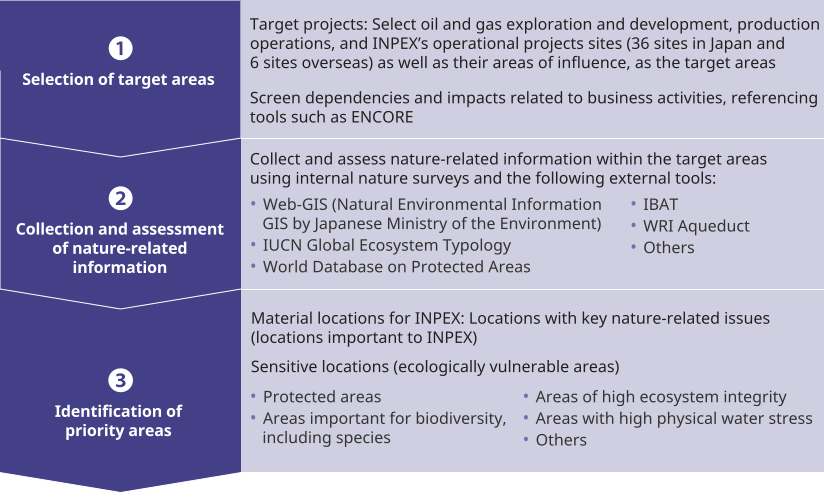
In the Locate phase, based on the TNFD guidance, we identified priority locations, taking into consideration the impacts of our operations' business activities on nature as well as the impacts of changes in the natural environment on our operations. We identified priority locations using the three steps below to understand their materiality to the Company and the ecosystems around the assessed sites.
Steps in the Assessment's Locate Phase
Priority Locations in INPEX's Operator Projects Identified in FY2025 Assessment
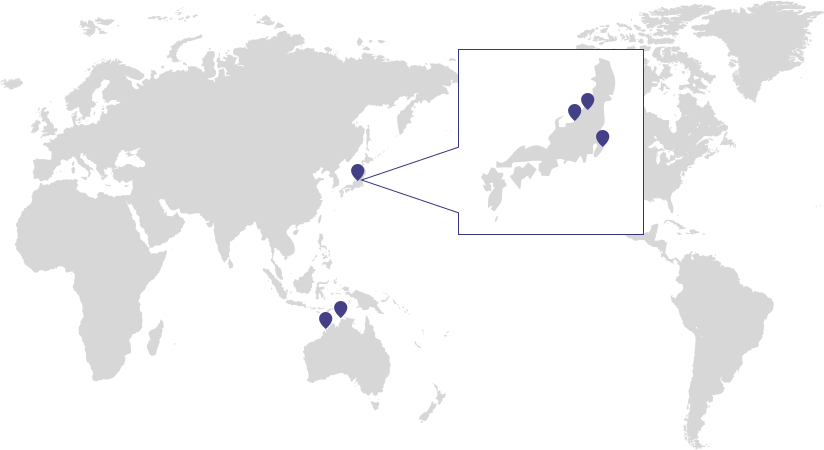
| Priority Locations | Business Activities | Material Locations | Sensitive Locations | |
|---|---|---|---|---|
|
Are there material dependencies, impacts, risks, or opportunities?
|
Is this an area with high vulnerability to nature, or adjacent to such an area?
|
|||
| Japan | Nagaoka Field Office | Production, storage, transportation, power generation, and underground storage of natural gas and condensate | ✓ | |
| Minamiaga Field Office | Production and transportation of oil and natural gas | ✓ | ||
| Chiba Field Office (discharge outlet) | Brine discharge during emergencies | ✓ | ||
| Naoetsu LNG Terminal | Storage and vaporization of LNG | ✓ | ||
| Australia | Ichthys LNG Plant | Production, storage, and transportation of natural gas and condensate | ✓ | ✓ |
| Offshore facilities (CPF, FPSO) | Production, storage, and transportation of natural gas and condensate | ✓ | ||
Evaluate (Evaluate Your Dependencies and Impacts on Nature)
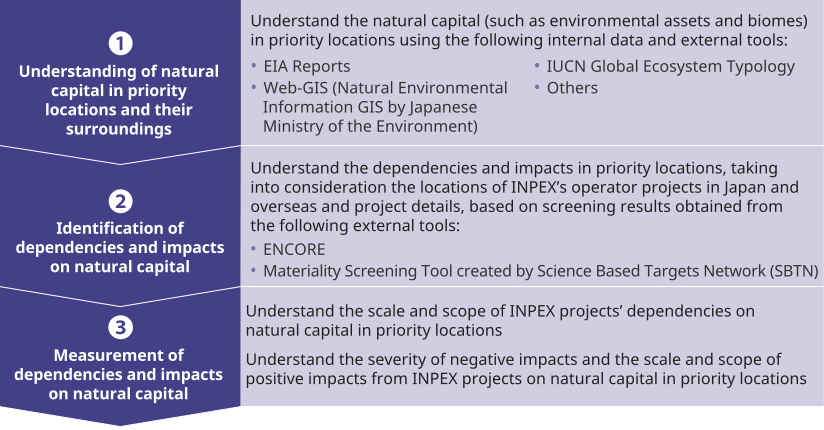
In the Evaluate phase, based on the screening results from ENCORE (Exploring Natural Capital Opportunities, Risks and Exposure)*2 and other assessment methods, we identified our business activity-related dependencies and impacts at our priority locations. The Group's business activities, which are categorized in the oil and gas development sector, have impacts on a range of terrestrial, freshwater, and marine ecosystems, as well as the atmosphere and aquatic environments around the areas of operations. We also depend on a range of ecosystem services for our operations. ENCORE assessments provide typical results for the sector; therefore we conduct our in-house assessment, including adding weights to the assessment items, with consideration to the locations and business activities of our projects in Japan and overseas.
-
*2ENCORE is a tool for assessing nature-related dependencies and impacts of each business sector and production process. It was developed mainly by the United Nations Environment Programme Finance Initiative (UNEP FI) and United Nations Environment Programme World Conservation Monitoring Centre (UNEP-WCMC).
Steps in the Assessment's Evaluate Phase
Dependencies and Impacts at INPEX's Operator Projects
The results of this assessment showed that the Group's business activities have an especially high level of dependencies on the following four ecosystem services coming from natural capital. These ecosystem services are essential for conducting stable operations and environmental risk management. It is necessary to carefully assess the impacts of changes in natural capital and ecosystem services on business.
1. Water Supply Service Necessary for Business Activities
A large amount of water is needed in the oil and natural gas production process. A stable supply of water is essential in the cooling process, and operational risks increase in high water stress areas. Please refer to Water Resource Management for details on our efforts for water resource management.
2. Dilution Service for Pollutants Emitted by Business Activities
To limit atmospheric pollution and impacts on water quality arising from our business activities, we carry out appropriate measures to prevent air pollution and treat wastewater in line with the laws and regulations of countries in which we operate, and international good practice. Furthermore, we depend on the ventilation and dilution functions of the natural environment (atmosphere, rivers, and oceans), and it is important that these functions are maintained properly. If the quantity or quality of water in a watershed declines, its dilution capability will drop, resulting in greater impacts on the environment. At the same time, there may also be impacts on continuity of operations. We will continue to comply with environmental regulations, strengthen air quality and water resource management, and study measures to maintain sustainable operations.
3. Climate Regulation Service for Stable Operations
Our business activities may be affected by climate conditions such as atmospheric temperature, rainfall, and wind speed. An increase in extreme weather phenomena (such as hurricanes, drought, and rising sea levels) may lead to impacts on our business activities, including changes to facility operation conditions and suspension of operations. Please refer to Climate Change>Governance and Strategy for details on our dependencies and impacts on climate regulation services.
4. Soil and Sediment Retention Service for Stable Operations (Nagaoka Field Office)
Ground stability is essential for the safe operation of facilities. The topography around the Nagaoka Field Office comprises flat grasslands and hilly and mountainous areas, with a mix of residential areas, farms, forests, and industrial facilities. Therefore, it is thought that there are high dependencies on the soil and sediment retention service provided by the surrounding vegetation. The occurrence of floods and storms around the Nagaoka Field Office may lead to land erosion, land subsidence, and similar events, and to impacts on our business activities. We clearly state risks related to heavy rain and floods in our risk register, develop manuals for proper management, and take other measures to achieve quick responses and minimize damage. We also established a structure for maintaining an alert status using a disaster monitoring system and hazard maps, and we take measures to ensure safety.
The assessment results identified two main factors impacting the natural environment due to our business activities. These factors—given their significant impacts on the environment—are directly linked to business sustainability and regulatory compliance, necessitating careful management and the implementation of appropriate measures.
1. Changes in Terrestrial and Marine Ecosystem Use in Business Activities
Changes in terrestrial and marine ecosystem use arise from our business activities. On land, deforestation and site preparation for facility construction may have impacts on the ecosystem and may lead to land erosion and loss of biodiversity. At LNG terminals located in coastal areas, land reclamation and dredging may lead to marine environmental changes or impacts on the ecosystem. We develop and implement management plans to minimize the impacts from changes in terrestrial and marine ecosystem use.
2. GHG Emissions from Business Activities
GHG emissions from business activities form a material impact driver for the loss of biodiversity arising from climate change. In our business activities, GHGs are emitted from various processes such as drilling, production, and transportation. Please refer to Climate Change>Efforts to Reduce GHG Emissions for details on our specific measures for GHG emission reduction.
Nature-related Dependencies at INPEX's Priority Locations
| Japan | Australia | |||||
|---|---|---|---|---|---|---|
| Ecosystem Services | Nagaoka Field Office | Minamiaga Field Office | Chiba Field Office | Naoetsu LNG Terminal | Ichthys LNG Onshore Plant | Ichthys LNG Offshore Facilities (CPF, FPSO) |
| Animal-based energy | - | - | - | - | - | - |
| Biomass provisioning | VL | VL | - | VL | - | - |
| Water supply | H | M | - | H | H | H |
| Genetic materials | - | - | - | - | - | - |
| Bioremediation | - | - | - | - | - | - |
| Soil and sediment retention | H | - | - | - | - | - |
| Water purification | M | L | - | - | - | M |
| Soil quality regulation | - | - | - | - | - | - |
| Dilution by atmosphere and ecosystems | M | M | L | M | M | H |
| Disease control or pest control | - | - | - | - | - | - |
| Air filtration | - | - | - | - | - | - |
| Flood mitigation | H | - | - | - | L | - |
| Storm mitigation | H | - | - | - | L | L |
| Climate regulation | L | L | - | M | M | L |
| Nursery population and habitat maintenance | - | - | - | - | - | - |
| Noise attenuation | - | - | - | - | - | - |
| Mediation of sensory impacts | - | - | - | - | - | - |
| Pollination | - | - | - | - | - | - |
| Water flow regulation | H | L | - | - | - | - |
| Rainfall pattern regulation | - | - | - | - | - | - |
| Visual amenity | - | - | - | - | - | - |
| Recreation (education, scientific, research) | VL | - | - | - | - | - |
| Spiritual, artistic, and symbolic | - | - | - | - | - | - |
Nature-related Impacts at INPEX's Priority Locations
| Japan | Australia | |||||
|---|---|---|---|---|---|---|
| Impact Drivers | Nagaoka Field Office | Minamiaga Field Office | Chiba Field Office | Naoetsu LNG Terminal | Ichthys LNG Onshore Plant | Ichthys LNG Offshore Facilities (CPF, FPSO) |
| Terrestrial ecosystem use | H | H | H | - | H | - |
| Freshwater ecosystem use | M | M | - | - | - | - |
| Marine ecosystem use | - | - | M | H | H | H |
| Water use | M | M | - | M | M | M |
| Other resource use | - | - | - | - | - | - |
| GHG emissions | M | M | - | M | H | H |
| Non-GHG air pollutants | M | M | - | M | M | M |
| Water pollutants | M | M | L | M | M | M |
| Soil pollutants | L | L | L | L | L | - |
| Solid waste | M | M | - | M | M | M |
| Disturbances | M | M | - | M | M | M |
| Invasive alien species | L | L | - | L | L | L |
| Social impacts | M | M | M | M | M | M |
Assess (Identification and Assessment of Nature-related Risks and Opportunities)
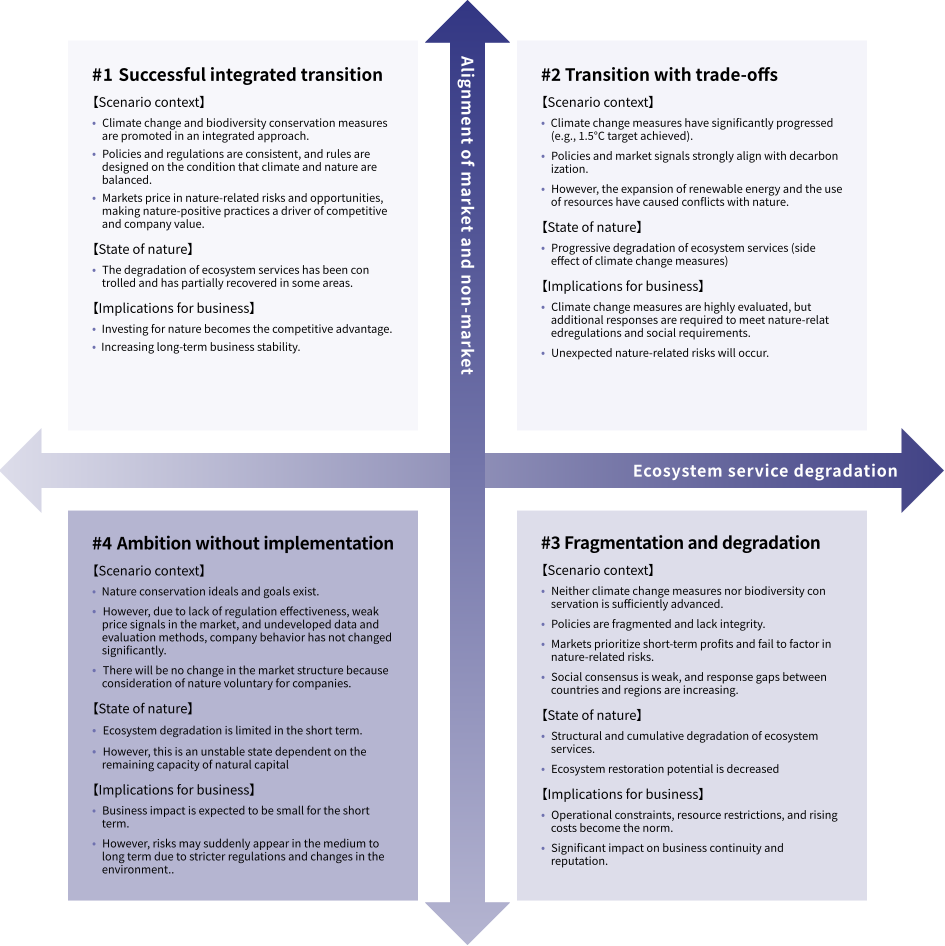
In the Assess phase, based on the interfaces with nature as well as the dependencies and impacts on nature identified in the Locate and Evaluate phases, we identified matters that could pose future risks to the Company. We also developed four scenarios to handle nature- and climate-related risks and opportunities in an integrated manner and to confirm and investigate the resilience of our businesses and the appropriateness of our response strategies under possible global situations. Going forward, we plan to also identify our opportunities, then assess the materiality of our risks and opportunities under each scenario and assign priorities.
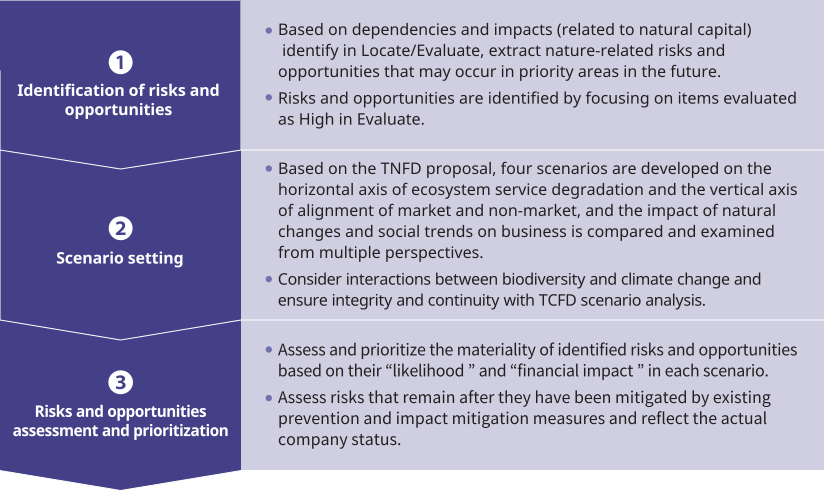
Identified Risks
Please refer to Assessment of Climate Change-related Risks and Opportunities at the End of FY2025 in the section on Climate Change for details on climate-related risks.
Transition Risks
| Risk Categories | Categories | High Dependencies/Impacts Identified through Evaluate Phase | Risk Description |
|---|---|---|---|
| Policies | Water resources | Water supply | Risk of restrictions on water resources available for operations due to the introduction of water withdrawal regulations resulting from tighter water resource conservation policies. |
| Land and sea use | Terrestrial ecosystem use / Marine ecosystem use | Risk of constraints on business activities due to protected-area designations and stricter development regulations resulting from concerns about ecosystem impacts caused by land development, deforestation, and seabed disturbance. | |
| Pollution and emissions | Dilution by atmosphere and ecosystems | Risk of limitations on allowable emissions due to tighter emission regulations, requiring additional measures and changes to operating conditions. | |
| Technologies | Water resources | Water supply | Risk of the need to introduce technologies for reducing water consumption and promoting reuse due to increasing requirements for improved water use efficiency. |
| Land and sea use | Terrestrial ecosystem use / Marine ecosystem use | Risk of the need to introduce low-impact technologies in land alteration and seabed operations to minimize impacts on ecosystems. | |
| Pollution and emissions | Dilution by atmosphere and ecosystems | Risk of the need to introduce new technologies for emission reduction and advanced treatment, requiring renewal of existing facilities. | |
| Markets | Water resources | Water supply | Risk of increased water procurement costs due to rising water prices resulting from increasing water scarcity. |
| Land and sea use | Terrestrial ecosystem use / Marine ecosystem use | Risk of impacts on business conditions and investment decisions due to growing environmental requirements for land alteration and marine ecosystem use (such as dredging, reclamation, and seabed infrastructure installation) that are considered to have significant impacts on ecosystems. | |
| Pollution and emissions | Dilution by atmosphere and ecosystems | Risk of impacts on business conditions and competitiveness due to increasing market and investor demands for emission reductions and lower environmental impacts. | |
| Reputation | Water resources | Water supply | Risk of reduced social acceptance due to criticism from local communities, NGOs, and other stakeholders regarding water use in water-stressed areas. |
| Land and sea use | Terrestrial ecosystem use / Marine ecosystem use | Risk of reduced social acceptance of business activities due to social criticism resulting from ecosystem impacts associated with land development and marine ecosystem use. | |
| Pollution and emissions | Dilution by atmosphere and ecosystems | Risk of impacts on business continuity and expansion due to reduced social acceptance resulting from criticism of emissions and environmental pollution. | |
| Liabilities | Water resources | Water supply | Risk of compensation liability arising from impacts on local communities and ecosystems caused by water use and wastewater discharge. |
| Land and sea use | Terrestrial ecosystem use / Marine ecosystem use | Risk of compensation liability due to damage to local communities and industries (including fisheries) resulting from ecosystem impacts caused by land alteration and marine ecosystem use. | |
| Pollution and emissions | Dilution by atmosphere and ecosystems | Risk of compensation or legal liability to third parties due to environmental pollution caused by emissions. |
Physical Risks
| Risk Categories | Categories | High Dependencies/Impacts Identified through Evaluate Phase | Risk Description |
|---|---|---|---|
| Acute | Water resources | Water supply | Risk of impacts on operations due to damage to water withdrawal facilities and water transmission infrastructure caused by extreme weather. |
| Land use | Soil and sediment retention | Risk of impacts on operations due to reduced stability of onshore facilities resulting from soil erosion and ground collapse caused by extreme weather. | |
| Pollution and emissions | Dilution by atmosphere and ecosystems | Risk of impacts on operations due to exceedance of discharge and emission standards resulting from increased concentrations of emitted substances caused by a temporary decline in the mixing and dispersion capacity of the ocean and atmosphere. | |
| Chronic | Water resources | Water supply | Risk of impacts on operations due to difficulty in securing the water required for operations resulting from reduced availability of water resources. |
| Land use | Soil and sediment retention | Risk of impacts on operations due to gradual deterioration in ground stability and increased facility maintenance burdens resulting from a long-term decline in soil retention capacity. | |
| Pollution and emissions | Dilution by atmosphere and ecosystems | Risk of constraints on operations due to the need to meet discharge and emission standards resulting from a long-term decline in the dilution and dispersion capacity of the ocean and atmosphere. |
Scenario Analysis
In formulating the scenarios, taking into account the TNFD recommendations, we depicted four future scenarios using two perspectives: the degree of ecosystem service degradation on the horizontal axis and the consistency of market and non-market (such as policies, regulations, and consumer awareness) trends on the vertical axis. The left side of the horizontal axis represents situations where the degradation of nature remains moderate or mild, and ecosystem services can continue to be used. Meanwhile, the right side represents situations where the degradation of nature is severe, and ecosystem services are collapsing. The upper side of the vertical axis represents situations where factors such as policies, regulations, and consumer awareness are aligned, and clear decision-making signals are being conveyed to companies. Conversely, the lower side represents situations where the business environment is unstable and risks are high, with factors changing in different directions and at different speeds, creating contradictory signals for companies. By combining these two axes to construct four scenarios, we could understand—from various angles—the impacts of changes in the natural environment and social trends on businesses, and we could compare and investigate how risks and opportunities manifest.
Furthermore, to comprehensively assess nature-related and climate-related risks and opportunities, we have incorporated the interaction between biodiversity and climate change, and we have also given consideration to consistency and continuity with the TCFD's scenario analysis.
Overall Concept of Scenarios
Specific Nature-related Initiatives
Based on the mitigation hierarchy, we implement initiatives to avoid and reduce negative impacts on biodiversity, and to regenerate and restore nature. We also actively collaborate with other companies and industry bodies, such as providing and collecting nature-related information through IOGP, Ipieca, and Society of Petroleum Engineers (SPE) conferences, and exchanging knowledge with energy companies in Japan and overseas.
Please refer to Biodiversity Conservation for details on our specific efforts for biodiversity and nature.
Future Initiatives
In the LEAP assessments conducted in FY2025, in addition to clarifying the relationships between our operator projects and the natural environment, we have also identified our risks and opportunities and formulated our scenarios. In FY2026, we will assess the materiality of the identified risks and opportunities and assign priorities, while continuing to improve our in-house assessment method. During materiality assessment, we plan to measure and assess materiality primarily based on the magnitude and likelihood of financial effects, then assign priorities. For risks, we will also undertake assessments that reflect our actual situation by assessing the residual risk level after minimizing risks, accounting for existing prevention and impact mitigation measures.
Related Page
-
Biodiversity Conservation and Environmental Pollution Measures>Water Resource Management
-
Biodiversity Conservation and Environmental Pollution Measures>Biodiversity Conservation
-
Disclosures in Line with TCFD Recommendations
-
Disclosures in Line with TNFD Recommendations