
Our Stance toward Water Risk Management
Our principle on water management is to understand the impacts of the INPEX Group's businesses on water resources and sustainability in local communities. In INPEX Policy and commitments on Water Management, we state that we advance efforts to mitigate impacts associated with water use and create value. Based on this, we calculate water balances and assess water risks in each of our businesses, and we set targets and formulate plans to implement water management according to the risks. We are also a member of IOGP and Ipieca, and we have obtained industry standards and best practices related to water management, including the reduction of water consumption and wastewater treatment. The guidance and knowledge gained from these frameworks are reflected in our internal operations, target setting, and other activities.
Water Risk Assessments and Identification of High Water Stress Areas
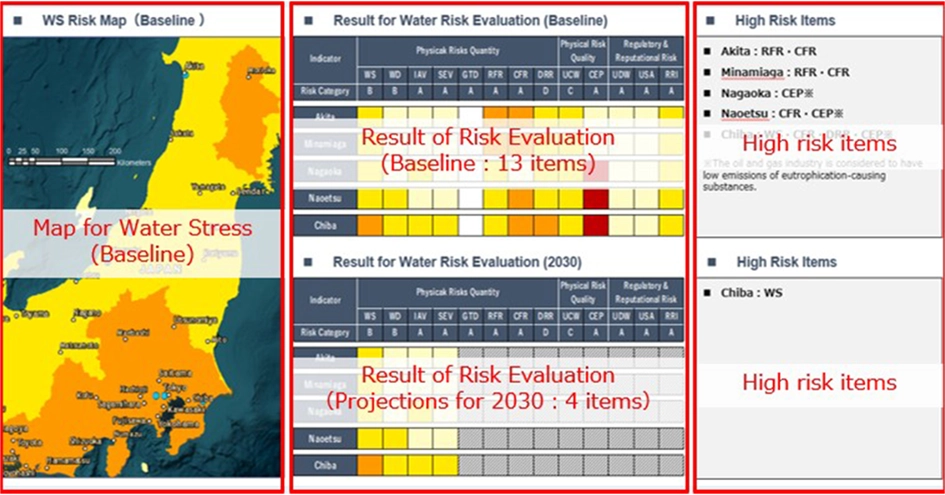
We assess water risks annually across all areas where our operator projects are located using Aqueduct, a water risk mapping tool developed by the World Resources Institute (WRI). The water risks we check include dependencies on water resources, impacts of our projects, potential future changes in water demand and quality, potential future regulatory changes at the local level, and reputational risks among external stakeholders. In FY2024, to further ensure the fulfillment and advancement of our commitments, we also established a Group-wide measurable quantitative target to maintain zero freshwater withdrawal in high water stress areas. As of the end of FY2025, we participate in five oil and natural gas projects currently in production and one oil and natural gas project under development as operator. Among these, the Abadi LNG Project, currently under development, is located in areas of high water stress. For this project, we are planning to install a seawater desalination plant to avoid freshwater withdrawal from the project area. In FY2025, we achieved our target of zero freshwater withdrawal in high water stress areas.
Since local water risks are influenced by various factors and change over time, we will continue to regularly identify water risks. If high water risks are identified, we will plan and implement additional measures based on the mitigation hierarchy.
List of Water Risks to Be Assessed Using Aqueduct
| Risk Categories | Indicators | Explanations |
|---|---|---|
| Physical risks (Quantity) | WS | Water stress |
| WD | Water depletion | |
| IAV | Interannual variability | |
| SEV | Seasonal variability | |
| GTD | Groundwater table decline | |
| RFR | Riverine flood risk | |
| CFR | Coastal flood risk | |
| DRR | Drought risk | |
| Physical risks (Quality) | UCW | Untreated connected wastewater |
| CEP | Coastal eutrophication potential | |
| Regulatory and reputational risks | UDW | Unimproved/no drinking water |
| USA | Unimproved/no sanitation | |
| RRI | Peak RepRisk country ESG risk index |
Risk Map of FY2024 Assessment Results of Risks in Japan and FY2030 Projections
Efforts to Contribute to Efficient Water Use
We conduct a material balance survey to understand water use and improve water efficiency for each operator project. The survey results are used to gain a detailed understanding of and analyze water use at each facility and in each process. We aim to continue reducing water consumption and improving wastewater quality while reflecting the insights gained from our understanding and analysis. The INPEX Vision 2035 and our annual plans also encompass environmental management efforts, including appropriate water use across the Group, promoting Group-wide environmental management. Please refer to Governance and Strategy for details, and Performance Data for details on our water risk-related financial information.
Efforts for Efficient Freshwater Use
Among the water resources used in our business operations, we recognize freshwater withdrawal management as a major issue in our water management. We have been working to reduce our impacts on water resources by managing the water withdrawal of our operator projects in Japan and overseas as well as the discharge of produced water arising from oil and natural gas production. Our operator project sites use freshwater (tap water, industrial water, and groundwater) mainly for cooling, power generation, and drilling operations. In FY2025, freshwater withdrawal across the Group totaled 1,373,000 m³.
Changes in Freshwater Withdrawls in Japan and Overseas
Unit: thousand ㎥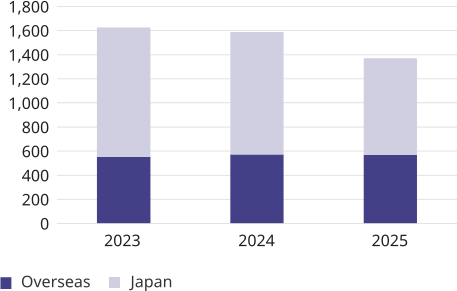
In addition to using groundwater for normal cooling and drilling operations in Japan, we also use it for melting snow in winter. We are also taking action to reduce our freshwater consumption, including by adopting a circulating system for cooling water, and equipping snow-melting systems with automatic start and shutoff mechanisms.
At the Ichthys LNG Project, we investigate freshwater consumption with the aim of reducing water consumption at the LNG facilities. We use the findings of these investigations to consider the feasibility of cost-effective approaches for reducing freshwater consumption by reusing water, such as treated wastewater from processing as well as wastewater and condensed steam from power generation facilities.
Efforts for Efficient Seawater Use
Instead of freshwater, the Ichthys LNG Project's offshore production facilities use seawater for cooling, and the Naoetsu LNG Terminal uses it for heat exchange in the vaporizer. At these sites, used seawater is discharged into the sea after confirming compliance with the laws and regulations of the countries in which we operate and international guidelines concerning items such as the temperature difference between withdrawal and discharge water and residual chlorine concentration.
Wastewater Management of Produced Water
Produced water from our oil and natural gas projects is reinjected underground, or discharged after confirming compliance with the wastewater standards of the countries in which we operate and international guidelines. In FY2025, 33% of the total produced water (approximately 810,000 m³) was reinjected, while the remainder was discharged into rivers or seas after treatment.
Changes in Produced Water Discharge in Japan and Overseas
Unit: thousand ㎥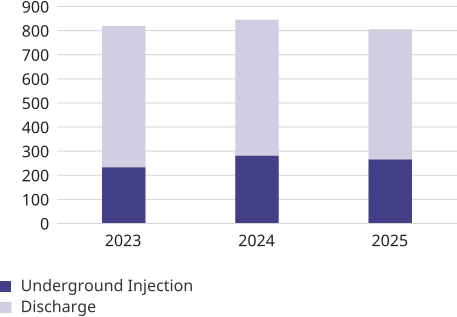
Appropriate Treatment and Management of Produced Water
At our operator projects, produced water is injected into injection wells—with maintained integrity—and returned underground, or discharged into rivers and seas after going through water treatment systems and meeting the standards stipulated in the laws and regulations of the respective country or region. Regarding the discharge of produced water into the sea, besides existing regulations targeting dispersed oil in the water, some countries and regions have gone on to adopt regulatory values that also include dissolved hydrocarbon components. For the operation of the Ichthys LNG Project, we also adopt a tertiary advanced processing system that uses Macro Porous Polymer Extraction (MPPE) to remove soluble hydrocarbons before discharging produced water that meets the standards into the sea.
Related Page
-
Biodiversity Conservation and Environmental Pollution Measures>Biodiversity Conservation
-
Progress of Action Plans for each Materiality
-
ESG data>Environment
-
Biodiversity Conservation and Environmental Pollution Measures>TNFD-related Initiatives